M8A front
With the restoration of the Trust M8A starting to race down the final leg, it is time for us to look back and recall the fascinating story and saga of this unique and very special Can-Am car. In reflection it behoves us to say, that had it not been for all the unusual events in the course of its history, then we would not be in the position of owning this car today.
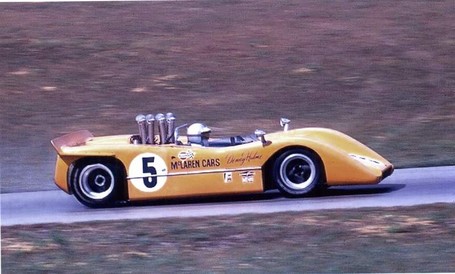
To start the story we go back twenty six years to 1967. This was the year of the M6A, the first of the orange elephants as they were affectionately known and of course, the first year that Bruce and the team won the highly coveted Can-Am Championship. The monocoque chassis M6A was hugely successful and at the season’s end, the McLaren works took Denny’s M6A, which had run a small block Chevrolet engine, cut the back off the tub and mounted a big block 427 cubic inch Chev motor to create the first M8A. The engine became a semi-stressed member.
And the power increased from around 516bhp to 640bhp. This coupled with wider tyres and changes made to body aerodynamics meant that the new M8A was going to lap about 3% faster.
M8A - The First Year
M8A-2, Denny Hulme’s car, was constructed at the McLaren Colnbrook factory in England in early 1968 by the team, which included New Zealanders Colin Beanland, Cary Taylor, George Begg and Chris Charles. The two M8As were only just ready in time for the opening round of the 1968 Can-Am series in North America and at Elkhart Lake the McLaren Team worked several all nighters to make the cars raceworthy.
The race itself was wet and Hulme, then the current World F1 Champion and seasoned in the rains of Europe, drove away to an early lead. Part way through the race Denny lost a valve rocker in his 7 litre engine. This wasn’t enough to stop the Chevy but on the last lap the now seven cylinder engine lost all oil pressure. He still had a forty second lead over his teammate, so he motored around the last four miles in top gear to collect the chequered flag.
At the next round at Bridgehampton, New York, the M8As had serious reliability problems, with Hulme dropping out when the engine started blowing white smoke. Mark Donahue went on to win in his McLaren M6B. The next round was at Edmonton in Canada and McLarens hoped they had solved their engine problems by reverting to Chevrolet off the shelf piston rings. Hulme and McLaren again pulled away from the pack but at the halfway mark Denny’s engine began smoking and the oil pressure began dropping. Dumping his reserve oil supply brought the pressure back up and by nursing the car home he won by 10 seconds from his teammate Bruce.
At Laguna Seca, California the race was run in terrible conditions with torrential rain, but Denny managed to salvage second place behind John Cannon in an old M1B. Then at Riverside, California when the team had confidence in their engines, Denny had the misfortune to veer off course and damage the front bodywork.. He managed to finish fifth and was still leading the series. The last round was at Las Vegas and Denny dominated this race and his win clinched him the Can-Am Championship for 1968 in M8A-2.
More Images: Click to view full gallery of high res images
|
