There were several bad performances, unfortunately, and that prize should be shared equally between the several non-competitive, way-out-of-their-class drivers, who, as one front-runner said, made it necessary to "take your life in your hands to get around them." There were six drivers that didn’t get under 1:42 on their fastest lap of the race (and several that were cruising at 1:50 and worse) which meant that they had to be lapped every 10 or 12 times around by the leaders, which was certainly no fun.
Deserving a good mark for the job they did was the Long Beach MG Club scoring team who kept everything straight throughout the several messes, pit stops, shufflings and re-shufflings. Until I saw their charts after the race I had no idea how far off my own lap chart had been.
For pure frustration, the worst luck of the weekend had to be that of Mark Donohue whose Penske-owned, Sunoco-sponsored McLaren M6B-427 Chev would not start on the grid due to a faulty coil. Donohue and McLaren were tied for 2nd in the standings going into the Stardust race and Bruce’s one big point for 6th place was worth almost $10,000 to him as he got $26,450 and Mark had to settle for $16,700.
Missing altogether from the Las Vegas field was John Surtees who simply came as a spectator rather than fight his Weslake-headed Chev engine through another weekend. He says now that he knows what the problems are and will be ready to go next year.
Ferrari’s luck was uncommonly poor. Finally arriving in this country in time for the last race, the basso-profundo V-12 worked up to qualify 9th-fastest at 1:32.20 (compared to McLaren’s 1:29.63). The car had suspension and braking troubles even in its brief practice periods and though it seems unlikely that it would have gone the distance, to have been eliminated in the first very turn was heartbreaking.
At the cocktail party in the Stardust Hotel on Sunday evening after the race, the $126,000 championship points fund ($90,000 from the six organisers plus $36,000 from Johnson Wax Co.) was divided up. In addition to several brief speeches, at $1,000 Sportsmanship Award from Triangle Publications was made to John Cannon. This selection, for "the driver who epitomises the highest ideals of a professional driver in skill, attitude and courtesy" was made by the drivers themselves and their choice was enthusiastically seconded by the crowd at the party.
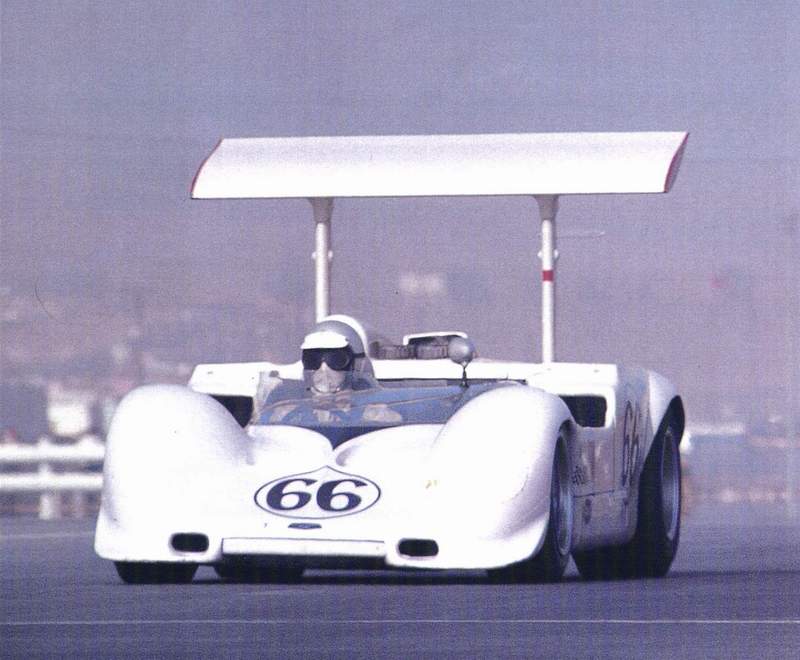
So the 1968 Can-Am season was over. Six races in ten weeks playing to bigger audiences and for larger amounts of money than ever before. The McLaren team was again outstanding, the only one that was ready to go out and win at every event. And, like last year, they made it look absurdly easy. Roger Penske’s Sunoco Special made the best showing for an American team but their combination of vehicle and operator was simply not quick enough to carry off first prize. Jim Hall’s season began badly when his new Chaparral wasn’t ready and ended with the unhappy crash at Las Vegas. Nobody else was ever in the chase.
So far as equipment goes, it was another great year for McLaren cars, Chevrolet engines and Goodyear tires. As last year, Ford did it all wrong and makes you wonder what Ford management can be thinking of to allow themselves to be committed piecemeal with far too little and much too late. Lola-chassised cars were in the same category as Ford engined-cars. Unfortunately, their best showing was George Follmer’s excellent 2nd place finish at Las Vegas.
For next year the series will be expanded to 10 events with races at (probably) St. Jovite, Watkins Glen, Mid-Ohio and Mosport in addition to the six held this year. The McLaren team will start next season with the M8As which were sufficient for the job this year. Penske has announced that he’s switching to Lolas next year and there’s a hint about four-wheel drive. As well as that there may be more than one car on the team. With Jim Hall’s injuries still unhealed, it’s no time to speculate about his plans for 1969. Dan Gurney, having announced that the Formula 1 Eagle project will be set aside in favour of racing in the U.S. next year, has promised a two-car entry for himself and Swede Savage. John Cannon has demonstrated he’s capable of better things that the Mark 2 McLaren he had this year. Surtees says he’ll be back.
We await the 1969 Can-Am with interest.
Article by James T. Crow Road & Track
More Images: Click to view full gallery of high res images
|
