They Came to Race
And that’s how the McLaren team made it look easy at the 1968 Can-Am series
Bruce McLaren is a nice enough little guy, and Denny Hulme shrugs his shoulders at most things including cleaning up the Can-Am championship, but the big question is: How did the two New Zealanders manage to walk away with the races so easily?
You know how it went for them, winning four of the six races and, if you will excuse me for saying so, only failing to win the other two because of freak things like both cars breaking at Bridgehampton and the untimely arrival of the winter monsoon at Laguna Seca. At every race it seemed as though they had come to the track ready to go out and race whereas the other famous hotshoes were using practice as a test session to find out what they should have already known before the series started. I saw the last two races in this year’s series and the superiority of the McLarens was almost embarrassing.
Early in the series the two McLarens were in oiling troubles that were cured when they junked their tweaky arrangement in favour of some more standard GM equipment in the piston ring department. Then they were back up to power par and it was an achievement to keep them in sight, never mind dice with them. Jim Hall and the Chaparral was the combination they feared most, although they knew the canny Penske would ensure Donohue was climbing the championship points ladder without risking his reputation or the motorcar in a track battle. The Penske policy paid off as Mark got 3rd place points money. Andretti, Gurney and Revson, three men who might have fielded a challenge to the McLarens, changed engines halfway through the series when Ford made a last-ditch attempt to foil the Chevy-powered walk-over. But the aluminium 427 Ford was an oiler and the teams who accepted Ford’s help must have wished they hadn’t.
Bruce McLaren is a New Zealander, he’s 32 and while he isn’t the fastest driver in the world, he makes up for any lack of natural talent with tremendous energy and engineering ability. He’s a cheerful stocky charger who looks like the boy next door, but he has been in the racing business longer than most people. He was racing an Austin 7 special in New Zealand when he was 15 and was Grand Prix racing in Europe when he was 21. He has also been racing in American events longer than most drivers. In 1960 he drove Briggs Cunningham’s prototype E-type Jaguar at Laguna Seca, and in 1961 he almost won Riverside in a Cooper Monaco. The following year he and Roger Penske shared a Monaco fitted with a Maserati engine at Sebring. "After that race I came back to England and asked Charlie Cooper if I could run the sports car side of the Cooper Car Company because I felt sure there was a tremendous market for this type of car to use an American engine for American racing. I was convinced at that stage that sports car racing was going to really boom providing there were cars available, and that it would be a great market for an English manufacturer. Charlie turned me down flat.”
Two years later McLaren bought the ex-Penske Zerex Special from John Mecom. The car had been sitting in the corner of the Mecom workshops under a dust sheet, along with an aluminium Oldsmobile engine that nobody had gotten around to fitting. After a couple of races in its original Climax-engined form, McLaren and his mechanics, Tyler Alexander and Wally Willmott, switched the engines in McLaren Racing’s first workshop – an unbelievably grimy shed that they shared with an earthmoving grader! McLaren won first time out at Mosport.
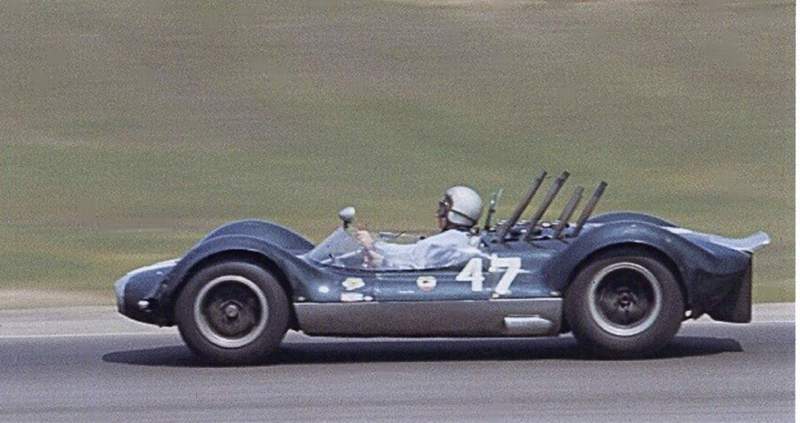
The Zerex’s chassis was a willowy affair, so McLaren decided to design a stiffer one. This tubular frame was completed and ready for painting one Sunday, but the only paint that could be found in sleepy England on a Sunday morning was a tin of garden gate green. So the car was christened the Jolly Green Giant. Because Bruce was still with Cooper in Formula 1 the car hadn’t really been called anything, nobody daring to call it a McLaren after the rumpus there had been when Jack Brabham started to build his own cars while still at Coopers! But there was no holding McLaren now. If he could build a chassis, he could build a whole car, so he did. He was convinced that a lightweight engine with a reasonable amount of power would be the equal of a cast iron engine with more power, the equalling coming through a superior power-to-weight ratio. It took two seasons for McLaren to realise that nothing beats cubic inches, and he switched to 6-litre Chevies for 1967. The M6As with their cast iron Chevies were conventional motorcars that won because they were well sorted, reliable and had impeccable attention to detail.
