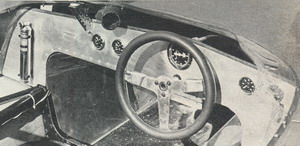
Above: The “office” is businesslike. Fresh air duct that may find its way in the cockpit at speed
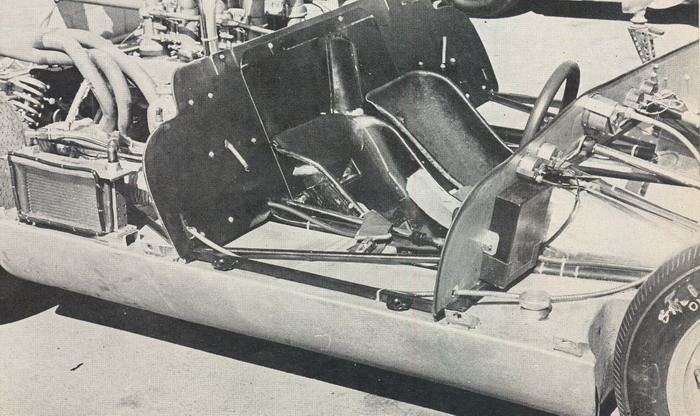
Above: Pannier fuel tanks are low mounted on both sides, outside of frame tubes, hold 62 gallons
McLaren
cast magnesium wheels are fitted, carrying Firestone "Indy" tires, with
two-inches wider track than before. His wheel design appears to provide
very good ventilation for the brakes, without sacrificing strength.
The bodywork fitted to this car is aluminum, and future copies, once finalized, will be made from fiberglass. One thing that has allowed Bruce to build a much slimmer, slipperier car is the revised F1A rules, particularly in the case of not having to carry a spare tire. Looking at the Series I, it appeared that the biggest design limitation was having to carry the spare above the driver's legs. Quite stubby looking, the new car is 14 inches shorter than the Series I.
The handling of the new car appears to be equal to anything going, Phil Hill stating: "It's the most honest car, with the best manners, I've ever driven." Phil liked the engineering, adding: "The controls are very consistent, and the brake equalizer really works."
Through the very difficult Turn Six at Riverside, we were able to get corner times from Shelby driving instructor John Timanus, who has special points of reference he uses in his classes. Timanus said: "The fastest cars through six were McLarens, with Graham Hill at 10 seconds flat in the Series I, while Bruce went through at 10.3-seconds. Graham's car had a bit more oversteer allowing him a slightly quicker exit." The oversteer probably hurt Hill in the quicker turns, Bruce having the faster lap times.
Part of the reason for Bruce's fast times can be attributed to what's under the rear hood. For some time now Bruce has been working very closely with Jim Travers and Frank Coons, the Whiz Kids from Venice, California known as TRACO. Their emblem shows a big arm with a dumbbell bending to its grip, bearing a tattoo with the words "STRONG MOTHER" in the appropriate spot. They aren't kidding.
Taking a little aluminum Olds block, TRACOizing includes an increase of displacement to 300 inches (five liters), adding an Engle roller-camshaft, with stock rocker arms, but a specially fabricated steel rocker stand. JE pistons are running' Warren-machine 'H-beam' rods that just don't give up, which in turn are motivated by a Moldex 3.400 crank. Pins are special, as are oversized valves, with rings by Perfect Circle. Four two-throat 45mm Weber carburetors ride on a special TRACO manifold. Horsepower has been increased over last year's 350 to a very healthy, long-living, 392.
Bruce chose the Olds over the bigger, more powerful Chevy because it is 200 pounds lighter than the Chevy, and with the Olds, lighter running gear can be used. There is less of a problem with weight transfer too. Dry weight estimates run right around 1285 pounds, with a ready-to-charge weight, including driver and fuel, right near 1550.
One of the key men in the McLaren operation is Tyler Alexander, who does much of the car building, and of course team manager, Teddy Mayer, who handles the business end, as well as the strategy. Assisting with preparation (you'll have to go a long way to find a better prepared car) is Bruce's namesake, "Little Bruce" and "Beany". Tyler says: "The only thing you can get, right now in racing that you can just turn on and have it absolutely right, ready to go, is a TRACO engine." It looks like the new McLaren can be added to that list.
Carl Haas, the U. S. importer, told us he plans to be able to start delivering copies in January, at about eleventhou, less engine, but with gearbox and tires.
Oh yes: Bruce is testing a new three-liter Formula One car with his name on it. If it goes like his sports/racing car...look out Wee Jimmie!
Reprinted from the Sports Car Graphic Magazine January 1966
