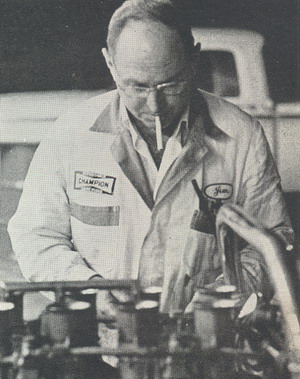
Above: Jim Travers of TRACO looks on Bruce's 5-litre Olds with tender, loving care as McLaren's use of their engines opened the European market for them. Below, the revamped Series II car has a stubby body that makes it appear smaller, even though wheelbase and track dimensions are the same. Its chassis and suspension have been strengthened and redesigned.
Above: Relatively blunt nose has good side-flow to help stabilize the car, cut drag in that area.
The rear suspension follows conventional practice, with a single upper sidelink, a reversed lower wishbone and trailing links for fore and aft location. Bruce is still experimenting with the upper-link length and pick-up point, trying to get the least camber change with a link about two inches longer at Kent than on the production versions, but at Riverside the car was fitted with the shorter link. The same size Girling calipers are fitted at the rear, as are fitted up front.
The rear anti-sway bar runs across the chassis below the trans-axle, along the rear frame bulkhead, mounted in Teflon, attaching to the upper end of the hub carrier via vertical ball jointed links. A choice of gearboxes is offered with the five-speed ZF being fitted to Bruce's, Oldsmobile version. Weighing but 127 pounds, the ZF is not considered heavy enough for use with bigger torquers, like Fords or Chevies, and for these applications Bruce recommends the 135pound Hewland LG-4. The wheels are driven through Mercedes Benz internally splined drive shafts.
Above: Long upper arms for the rear suspension were used at Kent, but replaced for Riverside race
Steering arms are sheet steel, doubled and boxed to support spherical joint top and bottom
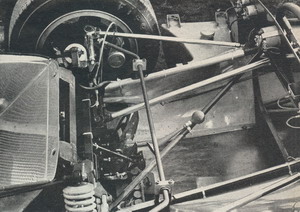
Front bay of the space frame car is typical of the efficient simplicity designed into it
