If you want to buy the fastest sports / racing car being built today, you'd better see Bruce McLaren!
Text & Photos: Pete Biro - Reprinted from the Sports Car Graphic Magazine January 1966
Just about a year ago, Bruce McLaren arrived to do battle on the North American continent with a brand new sports/racer, designated the McLaren I. With it Bruce proceeded to take the circuit record at Mosport, just missing the record at Riverside, winning the qualification race and barely missed taking the whole show because of a minor non-design-caused burst water hose.
Following these very successful performances, Bruce contracted Elva Cars to produce his design in quantity, for sale to aspiring Chaparral hunters. In all there were eighteen Series McLaren I produced, with thirteen of them running in North America. Three chassis were built by McLaren's own crew; the one he raced last season (which is now used for tire testing), one car which he calls "half production" built for Dan Gurney, and now a new car for himself, the Series II, with evolutionary, rather than revolutionary changes.
From all outward appearances the new Series-II McLaren looks like a completely new car. The original bodywork has been scrapped and a new body-designed by English artist Michael Turner has been fitted. Turner did not have a completely free hand to draw just what he wanted from a purely aesthetic viewpoint; Bruce set down a very rigid set of cross section and aerodynamic requirements, and after the final drawings were made, a model was built for wind tunnel testing. Much attention was paid to the drag and lift characteristics, with a net result of about 20 percent less drag than with the Series I. Radiator ducting studies were conducted to achieve the optimum flow characteristics.
Following contemporary practices, a spoiler has been fitted to the tail of Bruce's car, but a very original bit of thinking went into its construction. It is fabricated from craft quality Plexiglass, and is clear, enabling the driver to see behind him. Many spoilers hinder rearward vision. After a couple of appearances it was noted that three or four other cars switched to clear Plexiglass spoilers.
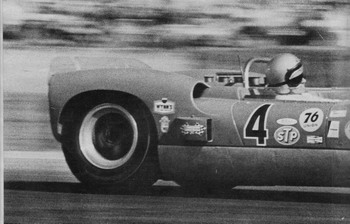
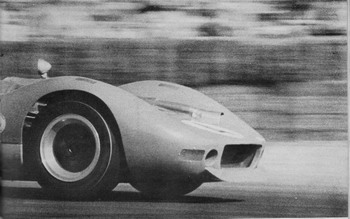
At Mosport this year in the new car, McLaren led 96 of 100 laps, only be overtaken by Jim Hall's Chapparal in the closing moments. At Kent Phil Hill took over the controls, putting up the only threat to the Chapparals, finally taking the lap record at 1:20 flat, Phil led until he was forced into the pits to repair a sticking throttle. Bruce skipped Laguna Seca and made his next appearance at Riverside, where he smashed the lap record with a 1:26.6, and easily won the qualifying race. In the main event, Bruce found himself in the wrong gear at the start, then in the pits to replace a flat tire, finishing a strong third, much closer, to the winner than the time consumed in his pit stop.
Like the Series I, Bruce's Series II is constructed of round and square tubing with only subtle changes made for strengthening. Four main rails are used, with truss-type outriggers above the side mounted, pontoon-like fuel tanks, adding to the rigidity. The floor pan, as well as the wheel-well sheet metal, is stressed. The firewall behind the driver is aluminum-alloy sandwiching a wood core, with a removable center door in the firewall to get at the front accessory drive units on the engine. A pair of semi-reclining alloy bucket seats are fitted.
Anti-dive front suspension layouts are used with very wide-based pickup points. The upper A-arm has a side link, with a leading arm attached to the cockpit scuttle-hoop. The lower A-arm is comprised of a side link with a trailing arm attaching to a forward frame member, placing the fore and aft suspension arms in tension instead of compression. Inclination of the upper arm reduces the tendency to nosedive under braking loads. An anti-sway bar crosses the frame above the driver's feet, angling forward to join the lower A-arm via a ball-jointed vertical link. The bar is carried in a Teflon bearing surface, is removable and is attached with screws. Telescopic shocks, wrapped with adjustable-tension coil springs are fitted front and rear. Girling BR callipers squeeze 12-inch Meehanite discs. Steel braided, Teflon, Aeroquip brake lines are fitted. which eliminate any spongy feel in the pedal. Cool air is fed to the discs via flexible hose, with the air inlets in the nose.
