The coolant radiator is still at the front, where the air extracted from it helps generate downforce. A large NACA duct in the left side of the body leads to the doubled-up engine oil coolers; a similar duct in the right flank in early season testing delivered air through three hoses to the rear brakes and the transmission cooler but now merely offers a light breeze to the engine bay. The transaxle cooler is now fed from the only NACA inlet in the top surface, one back under the wing. The rear brake discs have neat little metal fabrications scooping up air from under the engine.
The Goodyear tires are designed especially for Group 7 and don't work well on anything else. They mount on 15-in. wheels at both ends, the front rims being 11 in. wide and the rears 17. The front "footprint" is about 9½ in. wide, the rear about 14¼, The tire pressures will be set at around 18 psi and the surface compound will run about 180 degrees Fahrenheit. A front wheel and tire, with weights and security bolts fitted, will weigh about 28lb (13kg), a rear wheel about 40lb (18kg).
Every millimeter of the car has been shaped by very careful, very expensive hands. Even a twin parked alongside is slightly different. Both machines will absorb every possible minute, the most painstaking care, the fullest devotion of the swarm of orange-shirted mechanics. After every day of use the cars are stripped for examination. Every critical part, which means nearly every part, is discarded on a strict time schedule and renewed as are cells in the human body.
When the McLaren is clipped together again, it drapes across its wheels with the loose grace of a relaxed athlete. Every line seems to suggest some vaguely evil purpose. The splayed injector horns, tinted light blue, plume from the glistening deck like outrageous irradiated flowers. Says Hulme:
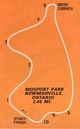
"Shooting up the straight you're going about 175. Right at the crest of the hill you've got to ease up on the pedal. You mustn't let the nose get too high, or you'll get air under it and you'll take off. You mustn't touch the brakes, either, because you don't want the tail to get light. You just ease over the hump, sort of float. Then once you're down you get all over the brakes, get down to third, for turn eight. It's pretty bumpy through there, the surface is terrible, and I stay over to the inside as I go in. You'll often find me taking a different line to everybody else. Out at Elkhart, especially.
"Once you get into eight the surface is smooth; in fact it's one of the few places here where it is smooth. So you can put a reasonable amount of power on early, and get it all on-or off-and-on-early. You'll find you can put the right front wheel up on the curbing. It doesn't disturb the car. You want to stay over toward the right of the road to be placed properly for nine. You come off the gas smooth and easy and sort of roll around nine to the left. I can't seem to get the car right in against the left curb for some reason, it wants to stay a couple of feet out.
"Then you can give it a bit of a squirt if you want to, and get right over to the left; hard braking, get down to second, and then straight across to the apex of ten and out the other side, keeping straight as the road drops off level. You don't want to give it too much power here, get too far sideways; you could if they'd build up the edge of the road.
I interrupt, saying I suppose another reason not to let the car power slide is that we understand it exaggerates this tire vibration problem everyone's been having.
"Don't seem to have that with these tires we've got fitted today. Can't seem to feel it. But you can go out and tell who has it and who hasn't. You can see it in the marks they lay down coming out of the corners.
"You snatch third past the pits, shoot under the bridge and get set up for one. Don't get too far over to the edge. Touch the brakes. It seems you could take it faster, but there are bumps all down through the first part and they make the car understeer. You mustn't toss the car. You must be smooth, let the car just roll in, or you'll hit the rail like that guy did this morning. It's a bit like Indy, this turn. You think you need to stay right in the groove but you'll find you can get away with leaving it to get around traffic.
"When you get the power on the car goes neutral. You can't actually nail it until you actually get out of the corner. The instant you just crack the throttles you've got forty percent of your power. We've got lots more horsepower and torque this year, and it's got just the same holes for the air to go through, and it all happens much more violently."
I say I remember the number of times last year he asked for a 430 because it was smoother to drive.
More Images: Click to view full gallery of high res images
|
|
