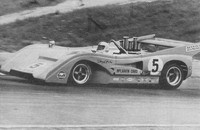
M8F
The latest and greatest Can-Am car and how Denny Hulme drove it at Mosport.
By Pete Lyons
“Balance," states Professor Hulme, thumbs tucked comfortably in his Nomex suspenders, "the whole theory of race cars is balance. That's all there is to it."
He's just in from practising Mosport laps. His new Can-Am car, in its first weekend at the front lines, has not been behaving well. The official qualifying times show the Scot Stewart is quicker, but now Denny is confident of holding him off in the race. The McLaren's tail had been loose, but now he's put a set of older, inferior tires on the front. Not a sophisticated solution, but it works. Balance.
Out in the sunlit paddock the Kiwis have pushed the long M8F into their roped-off bay and stripped off its bright ochre panels. Its bare metal structure seems a familiar sight. It looks like Lothar Motschenbacher's ex-factory M8D a few bays away, and really it looks like Roger McCaig's brand new M8E across the path. The F is in fact a direct progression of the M8 series that have served so well these three years past. Back in the Colnbrook drawing office, we know from the stimulating new USAC and Formula 1 cars, there are plenty of fresh ideas. There are plans for a new Can-Am car which, if built, will be the M20. But probably the F is going to be enough change for this year.
First, the basic car is longer. Three inches have been added to the middle of the tub and now the wheelbase is 98 in., which should have the effect of shifting a fraction of the weight aft and improving braking stability. But the track, which last year went wider in contravention of long-standing McLaren thinking, is narrower again; 60 in. front, 58.8 rear. The suspension geometries are altered, giving modified camber-change curves at both ends and a bit more anti-squat at the rear. The front upright castings are straight off the Indy car and give slightly different geometry as well as being much more rigid. The weight of the rear brakes has been moved inboard next to the transaxle; the intrusion of the l2-in. discs here has forced replacement of the accustomed reversed A-arms with Surtees-style parallel links, which minimize bump-steer.
The transaxle itself is Hewland's new LG 500 Mk II, distinguishable by its much beefier case and side plates. It follows modifications McLaren made to their own Mk Is last year. The big engines have been giving the hapless internals a bad time; this new case should position them more firmly.
The monocoque's fuel-tank sides are made of 0.062-in. sheet to try to prevent shunt-punctures. This is pretty heavy stuff and permits the rivets to be recessed aircraft style. It looks neat, but any effect on streamlining must be negligible. The driver's footwell has been braced with a new hat section hoop, again with the odd collision (fact of Can-Am life) in mind.
Compared with the M8E customer car, the F has a few things made of more exotic materials, magnesium and titanium, and here and there some pieces may be thinner; but the overall weight cannot be very much less. Empty of all liquids the complete car probably scales close to 1550 lb (704kg).
There are two engine options. Gary Knutson, back after two years at Chaparral, builds up normal aluminum-block Chevies displacing 494 cu in. (the 4.44-in. bore of the 430 block with the 4-in. 454 crank) and fits the injection with staggered intake trumpets.
For Mosport he'd developed a torque curve that bulged up to some 600lb-ft and continued to 700 in a straight line over a 1500-rpm band. Peak horsepower reading was about 740, but with Apollo-booster push like that the actual peak seems academic. The drivers were supposed to hold the revs below 7000, but dyno tests have seen these engines running at 7800.
The other option, not used at Mosport, is "the Reynolds motor" with its Vega-type sleeveless block. Partly because of piston-supply problems McLaren has fixed the bore of this at 4.50 in., and in an effort to make it a free-revving unit has elected to use the 427's 3.75-in. stroke, which gives 480 cu in. The trusty slide rule calculates that with the 4-in. crank, displacement would go out to 512 cu in. It would seem that the 800-bhp Can-Am car is not far away, but whether the current bottom ends could hold it inside for 200 miles is perhaps another thing.
Despite what rulebooks seem to think, the first job of the body is to generate squash. To this end last year's add-on "fences" have been made integral and run the full length of the body. Air shovelled up from the wedge nose is supposed to stay on top of the body, pressing down as it flows past, and on its way out over the stern the wing throws it upward again. Most of the inlets that used to be let into the top of the body have been relocated to interfere as little as possible with this airflow. The rear body line ducks down more sharply than it did last year to give the wing more room to work in. For what it's worth in terms of less drag, the side fins are thinner this year, because they no longer carry the full weight of the wing as they did before Bruce McLaren's crash.
More Images: Click to view full gallery of high res images
|
|
