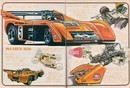
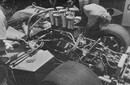
Under the skin probably every piece, familiar or not, has been revised. The "beam," the rear crossmember which carries the top suspension, is much stronger this year and the lower pickup casting is more elaborate to feed the loads into the differential casing more evenly. With stronger U-joints, they measure about 0.75in. wider. Denny is content to have his rear brakes inboard again this year. One of the maintenance improvements is the method of mounting the front of the engine: as before it's hung on a plate running across the chassis but this time the plate is actually three pieces butted together with "fish-plates." When changing engines the "fish-plates" are disassembled and the central portion of the main plate, complete with all three pumps, comes out with the engine. It saves a little time, yes, but the mechanics say a bigger bonus is that the pump installation has all been dyno-tested with the fresh engine, so they know it all works and doesn't leak.
When testing the prototype M20 a great deal of worry went into getting the radiators to work their best. Several different detail configurations of inlet duct had to be tried before the final arrangements evolved, and the same trouble was caused by getting the air out. Also, the first radiators of aluminum had to be replaced with copper ones – apparently copper can be in thinner sheets and you get more flow through a given size core.
Once out in the world there had to be several significant changes. At Mosport the two new cars did not go well at all. Part of it was engines, part of it was tires: Hulme says Mosport proved to him and to Goodyear that the Porsche and the McLaren need different tires, and part of it was indicated by the changes made for Atlanta a month later. There were modifications to spring rates at both ends and the track was widened about 2in. To be specific, both cars had spacers of 0.9 in. put under each front wheel, and Hulme's car had longer links to do the same job at the rear, a job so involved that only his car was done at that time. By Watkins Glen both cars had the new track measurements and it was done at both ends by longer links and wishbones. Brake cooling ducts were let into the front slope of the nose, replacing the original inlets which had been obscured behind the front airfoil in the panel ahead of the footwell. Another change was to reposition the rear airfoil some 6in. more to the rear; this was done at Atlanta on Hulme's car in testing and later transferred to Revson's car to compensate for his not having the wider rear track.
The advantage seems to be to get the wing back in cleaner air so it can work at a lower attack angle. In fact it proved a 2-edged foil; Revson kept it at the Glen and found he was indeed able to pull up on Hulme on the straight, but in the corners when following in the "dead air" behind the leading car, which always robs the front of adhesion, the added leverage of the rear wing created even worse understeer than usual. In practice at Ohio he found its leverage increased the "pitch-back" on acceleration out of the slower corners and generated too much understeer. And he removed it for the race.
Another change to the aerodynamics was in two stages and was once again aimed at taming understeer. At Atlanta both cars had little molded lips, or "shovels," riveted to the front edges of the body to prevent air going down from the stagnation point and around the edge under the car. These remained for the Glen race, and at Ohio the same treatment was applied to the leading edge of the nose airfoil.
Aerodynamics demonstrated its truly awful power on the 5th lap at Atlanta when Hulme's car flipped backwards like a hydroplane gone amok. Apparently it was a nasty combination of circumstances: he was close behind Follmer in the Porsche, which robbed the McLaren of nose adhesion; he had just gone over the crest of the rise in the back straight and he had just hanged into top gear so the nose was pitching up as the clutch gripped. Perhaps, although he doesn't remember anything about it, he was just then darting out of the Porsche's draft and catching a sudden blast of wind. The combination of effects was enough to raise the nose into an angle of attack, giving positive lift rather than negative-several hundred pounds of lift. Ugly, ugly.
Denny has a sturdy New Zealand skull and recovered quickly. Two weeks later with his new car (actually the prototype refurbished to the latest specs) he ran away with the Watkins Glen Can-Am flag-to-flag.
More Images: Click to view full gallery of high res images
|
|
|
|
|
