The next stage of evolution as practised by Can-Am's Establishment
By Pete Lyons
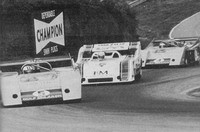
Although they usually manage to avoid producing camels, the men at the McLaren establishment operate as a committee when designing new cars. They are a conservative group – racing experience produces conservatism and don't seem the least bit sorry not to have a reputation for wild innovation. When they do lay down an all-new racer it's apt to draw heavily on what worked before. So it is with the M20. Most of the pieces are familiar and everything is good, sound, sturdy McLaren practice. Yet it is a much better car and seems to have achieved everything the committee wanted after teething troubles were sorted out.
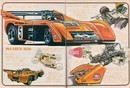
Gordon Coppuck: "We've taken great pains to get the weight distribution about the same as last year's car, but with a lower polar moment of inertia (isn't that an Eskimo's tea break?) to produce a quicker and more predictable car. We've added two inches to the wheelbase, although there's an 8-in. spacer ahead of the gearbox which moves the engine up more toward the middle of the chassis. The driver has been moved forward as well, while the radiators are back amidship and the fuel is maintained in a more compact mass."
Isn't much of this similar to last year's Lola T260 in layout? "I feel Eric made a mistake on that, doing it like a Formula I car. A slidey, throw-it-around sort of car. Our experience is that a Group 7 driver who throws it around is going to lose it. We prefer to have the car stick right down to the ground."
Tyler Alexander: "The first thing we wanted to fix was a problem we'd had on the earlier cars… I'm not going to say what it was."
"Was it a matter of front-end adhesion?"
“Ah… partly."
Teddy Mayer: “The first reason for the radiators in the sides is to lower the cockpit temperature, but it also allowed us to do more with the aerodynamics at the front, create more aerodynamic efficiency. And we got it, we were about 10mph faster on the straight at Watkins Glen this year – about 192, I think.
"Then we wanted zero change in the weight distribution between full and empty, and we've pretty well achieved that. There are some small geometry changes; the track and wheel¬base are bigger. The car is about 25lb (11kg) lighter than last year's, and it's got a lower polar moment and also the weight distribution is changed; it's a little more toward the front. The roll centers are 'in-the-air'-above ground. There isn't any anti-dive. There is some anti-squat, about the same as last year or maybe a little more. The radiators are something like 25 or 30 percent bigger in area, not because they have to be when you put them on the side but because the M8F's cooling capacity was pretty marginal.
"Gary's improved the engines quite a lot this year – at Mosport our engines weren't good but they are now. There's a little more horsepower and the torque is better, it's flatter, it doesn't drop off so much at high rpm.
Peter Revson's impressions: "It's a better balanced car than the M8F and there's less understeer. Because the balance is better you're able to get out of the turns faster, get the horse¬power down to the ground better coming out of the turns. I can't say I can really feel this 'lower polar moment' subjectively. But the cockpit is cooler, a lot cooler."
Denny Hulme: "We wanted it to run cooler, that was the main thing – and it made all the difference at the Glen this time, I can tell you! And it's a faster, better balanced car. I don't know about the 'low polar moment' business; it's not something you can feel in the seat of your pants. What makes a race car quick is balance. What's happening at one end you want happening at both ends, even-steven. You want balance; else you'll fall off the high wire!
"Basically there's no change in weight distribution between the start and finish. It's very good and it stays fairly neutral. Quite often in the F1 car we've got that problem but not in the Can-Am car now.
"And we've got some mighty brakes. That's mainly due to Lockheed; they've spent time with us getting big, light brakes. At first the pedal wasn't good enough, but it's slowly become better. The brakes are better, especially when you consider the work they do, the energy they have to absorb; it must be enormous, if you calculate it.
"There are some geometry alterations, but I can't really describe what they are – close as I am I don't really take much notice, and an outsider wouldn't have any idea. You never know the effect subjectively of these things, it's just a quicker car or it isn't. Everything we've done has had a slight effect and it all adds up."
More Images: Click to view full gallery of high res images
|
|
|
|
|
