The showdown with mighty Porsche
Then came the news that Porsche would mount an all-out challenge for the 1972 Can-Am, and would have its efforts managed by the highly professional Roger Penske for another skilled driver/engineer, Mark Donohue. At last, after so many years of fighting paper tigers, the showdown had arrived. The Can-Am town would ultimately prove big enough for only one of them.
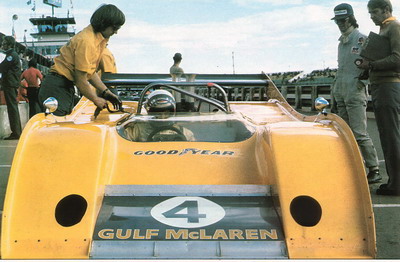
Coppuck's response was an all-new McLaren, the attractive M20. To pack as much weight within the wheelbase for a low polar moment of inertia, he moved the water radiators to the sides, supplemented the usual sill fuel tanks with one behind the seat, and stretched the wheelbase to 100 inches (254cm). Suspension remained much as per M8F but the bodywork was neater and an aerofoil was slung between the two front wings. In testing, the car was quick, and won praise from drivers who appreciated the fact that cockpit heat from front radiators was now a thing of the past.
First blood at Mosport
McLaren's other secret weapon for 1972 was a deal with Jackie Stewart but when he had to pull out due to a stomach ulcer, Revson was asked to combine the Can-Am with his McLaren commitments in USAC.
It was Hulme who drew first blood at Mosport on 11 June, baptising the M20 with a lucky win. Donohue had run into trouble but staged a fine recovery and just failed to pip Denny's sick car. Revson was third. At Road Atlanta, Donohue was replaced by George Follmer after a huge testing shunt and while the American sped to an early debut win, Hulme back flipped at 190 mph (306 kph). He escaped with no real injury, while Revson set a new lap record but retired with no oil pressure. At Watkins Glen it was Follmer's turn for trouble, Hulme heading Revson for an M20 1-2 with Francois Cevert third in Greg Young's ex Revson M8F. Then, for the first time in a long while, the works McLarens were soundly thrashed at Mid-Ohio. Follmer won, Oliver was second in a new Shadow and Milt Minter's Porsche beat Hulme for third. Follmer won again at Elkhart Lake after polewinner Hulme suffered ignition failure. Revson had a dud clutch, but Cevert was second despite a sick engine.
Worse was to come, for Donohue was out of hospital for Donnybrooke, ready to back series leader Follmer. A ferocious duel saw the M20s stay with the turbo Porsches until the British cars blew their engines; Donohue then blew a tyre and Follmer ran short of fuel on the last lap. Through it all, like a knight on a charger, came Cevert to win.
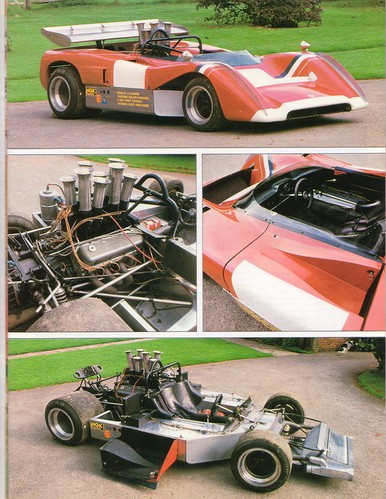
ABOVE: Views of another ex- VDS, ex Johnny Jordan McLaren M8E, used in both Can-Am and lnterserie racing. For many years this car held the lap record at Silverstone: 50 seconds dead
The writing on McLaren's wall
That, however, was to be McLaren's 43rd and last Can-Am win. Donohue won at Edmonton after Hulme led for a while, could have done so at Laguna Seca but slowed to let Follmer through to clinch the title, and then had the compliment returned at Riverside only to pick up a puncture, handing George his fifth win. The writing on McLaren's wall said only one thing: get out of town.
The M20s could often match the fast Porsches' practice pace, but come the race reliability lay with the German cars. The M20s either had to run off pace with detuned engines, or risk mighty breakages if they tried to match their rivals' power advantage. Hulme frequently bitched about screwdriver-tuning for extra power, something that would eventually become familiar in the GP world where, ironically, turbocharged McLaren-Porsches would prove so successful.
Private McLarens appeared in the 1973 Can-Am and Europe's Interserie equivalent, but the works cars never raced beyond 1972. In the last Can-Am race of 1974 at Road America, Elkhart Lake, Scooter Patrick had a lucky win in an ex-works car after Jackie Oliver's Shadow blew up. They had had their period of dominance - one of the longest in any professional racing series - and had in turn been dominated. Neither Teddy Mayer nor Phil Kerr of McLaren felt inclined to try matching Porsche's vast budget in the development of turbocharging and as Denny Hulme finished runner up to George Follmer in that 1972 series, the end was finally written to an outstanding chapter in road racing. Thereafter McLaren concentrated on the high-power arena of Formula One.
