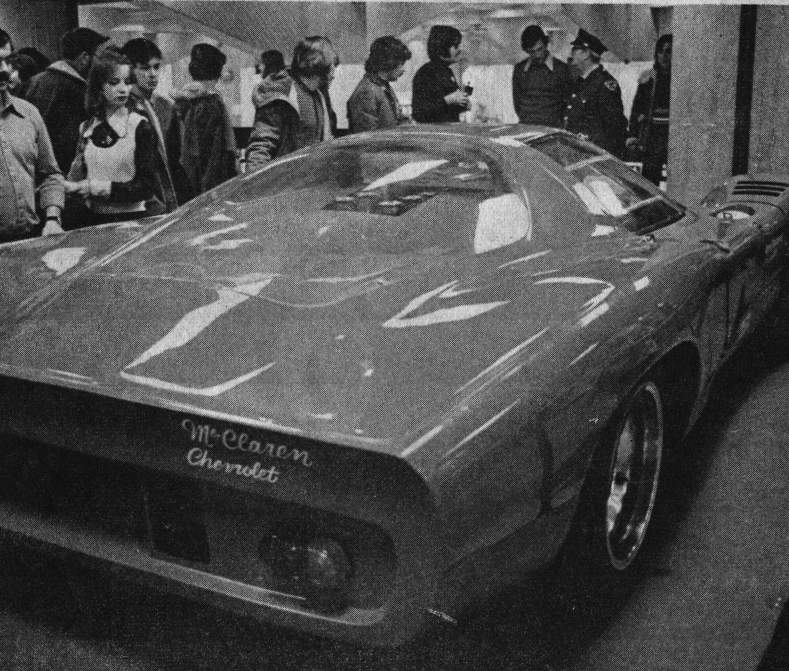
McLaren M12GT |
||
 Would you buy a car if you had to persuade the dealer to put an
engine in? Would you wait three years for delivery? Would you accept it without lights of
any kind? Would you agree to no guarantee whatsoever? If you can answer "yes" to
any of these, then you’re either an out and out nut or a very happy French Canadian
named Fournier, who is the owner of an altogether unique and highly treasured means of
transportation – the sole existing M12GT McLaren – a derivative of Bruce
McLaren’s personal grand touring prototype that almost made it to the world’s
car marts. Would you buy a car if you had to persuade the dealer to put an
engine in? Would you wait three years for delivery? Would you accept it without lights of
any kind? Would you agree to no guarantee whatsoever? If you can answer "yes" to
any of these, then you’re either an out and out nut or a very happy French Canadian
named Fournier, who is the owner of an altogether unique and highly treasured means of
transportation – the sole existing M12GT McLaren – a derivative of Bruce
McLaren’s personal grand touring prototype that almost made it to the world’s
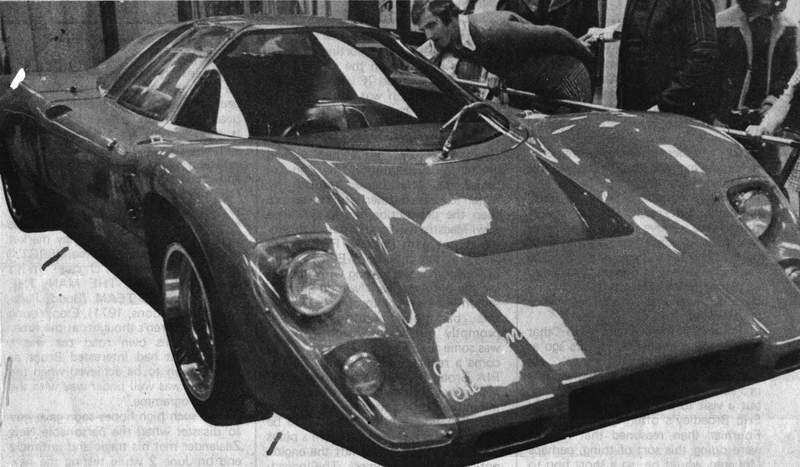
car marts.An attitude such as Fournier’s is scarcely representative of the masses’ choice of motoring media, for a keen interest in cars is not at all a commonplace among North American road users. Indeed, the reaction of virtually the entire car-driving population west of the Grand Banks and east of the Pacific can best be typified by that of a former employer of ours who shall remain nameless: "If I turn the key in the morning and it starts, that’s good enough for me!" The enthusiast minority, on the other hand, has several methods of avoiding assembly-line obsolescence – designing and building their own cars, mortgaging their earthly wealth for a limited production "classic" or- the ultimate – amputating one’s right arm to acquire BMW’s Turbo, Coggriola’s Volvo, or Vega’s project XP-898. Each of these is possible, all require a modicum of knowledge (expertise even), but there is one inescapable common denominator – cash by the carload! Thankfully, there are still a few fortunates who aspire to the last avenue of vehicular "soul". Andr� Fournier is one member of this elite group. And he would appear to have all the necessary trappings; youth (he’s only 33), married (with two children) – though this is hardly a prerequisite – and varied business interests that include a travel agency, a dry-cleaning establishment, and Automobiles Andr� Fournier Inc., a GM franchise dispensing Chevrolet and Oldsmobile cars, all in the city of Waterloo, about 65 miles south-east of Montreal. We rhetorically asked whether such accoutrements made paying for the upkeep of this pride and joy easier to bear! He laughingly replied: "Well, it does, naturally, but really, it’s the type of thing I like. I love cars, and, as far as that baby is concerned, paying for it hasn’t been a problem at all, because I’ve had as we say in French ‘beaucoup de plaisir" (kicks, if you will), in having it and owning it. It’s been very worth while." Fournier’s involvement with "that baby" began almost four years ago as the result of a trip to the UK. He had heard that Lola were involved in project to put GT coupes on the road, but a visit to the Slough works found Eric Broadley’s offering a bit pricey. Fournier then reasoned that if Lola were doing this sort of thing, perhaps McLaren would be, so a short hop to Colnbrook commenced a bargaining session that was to last almost three years. The first inkling that Bruce McLaren indeed had the more sporting motorist in mind appeared in the racing press in mid 1968, when it was rumoured that consideration was being given to the homologation of a coupe version of the McLaren-Elva sports racing car to compete with the Lola T70 in Group 4. The M6A had proved eminently successful in the Can-Am Series, so what better test-bed by which to assess the merits of the venture than the production line M6B? The Kiwi Maestro had fond hopes of thrashing it out with Porsche, Ferrari; and Alfa, on the circuits of Europe, and besides, what was wrong with importing the old American "win-on-Sunday-sell-on-Monday" philosophy? Hearing this background story, Fournier promptly put down a deposit, but it was some time before his dream was to become reality. Revised rules for the FIA Group 5 World Championship for Makes had been altered to require a minimum of 50 identical models before homologation. And they had to be complete cars, unlike McLaren’s plans for the M6BGT which left the engine option to the customer. The longed-for homologation papers were, therefore, never to materialise, and the project started to die a slow death with Fournier’s deposit being returned. Early in 1970, however, McLaren had a prototype prepared using one of 50 all-enveloping bodies (which had been delivered for homologation purposes) to surround a stock M6B chassis. It soon became his favourite project, and, amid speculation over an unusual vehicle making a hash of traffic in and around Walton-on-Thames, Trojan Cars released the news that they had in fact cobbled up a road-trimmed version "for evaluation purposes, as it is possible that Trojan may market a road-going version of the M6BGT." Back cam Fournier’s cheque! In his book, "McLaren’s thoughts at the time: "Building his own road car was a project that had interested Bruce as an ambition to be achieved when the company was well under way with the racing programme". But such high hopes soon gave way to disaster when the personable New Zealander met his tragic and untimely end on June 2 while testing the new model M8D Can Am car at Goodwood. Much ground had been covered in preparing Fournier’s car, and, in fact, delivery was imminent (though without an engine, contrary to expectations). But, with Bruce’s death, negotiations naturally came to a halt, not to be resumed for almost two years. Finally the eventful day arrived, and it was one happy fella that met a BOAC cargo flight at Montreal’s International Airport to take over his charge, in May, 1972, almost three years after he had first broached the subject. What Fournier got was a far cry from that originally planned. In the first place, the designation "M12GT" is entirely applicable (see table), and it appears that one of the available sets of M6BGT coachwork was shortened and widened to accommodate the M12 chassis. The M12 had been the 1969 production-line sports racer, and, though basically similar to the M6 series, most thought it a retrograde step. It nevertheless sold a plenty. Our subject vehicle seems to be the odd-ban on a quarter, and is, therefore, all the more exclusive. The prototype M6BGT was sold to Britisher David Prophet, who raced it for a time then converted it to a roadster. Its present whereabouts are unknown. One was prepared by Trojan for McLaren to undertake his feasibility study and a third was assembled in Croydon for Trojan to put on exhibition. The chassis number of Fournier’s M12GT is 50-04, which would seem to indicate that it is the fourth in a projected run of 50 which ties in nicely, but information is sketchy on the chronology of its predecessors. We learned recently that Bruce’s personal car will shortly find a permanent home in a museum in Auckland, New Zealand. Along with his prized possession Fournier received a set of M12 Group 7 coachwork (in case he ever wanted to race it, we expect), a large supply of spares, and an engine. This last was victory for the lucky owner, since Teddy Mayer had not been doing well disposed towards coming an engine supplier! But what was received was not as anticipated. Instead of the 302 cubic (Chevy V8, he found that a Webber carbed, 350 cu. Incher had been substituted. It turned out that this power plant had been built by the Californian Al Bartz and subsequently "McLarenized" at Colnbrook. Included in the specification were dry sump lubrication and a bhp rating of 575 at 8000 rpm – a bit long-legged perhaps, but more in keeping with the more leisurely pace of North American traffic. The whole question of performance is academic really, which you learn that Trojan’s John Bennett virtually guaranteed a 0-100 mph time of 8 seconds and a top speed of 225 mph! Upon arrival at the Waterloo shop, a complete tear-down was dictated, not so much to correct as to examine! A full complement of legal lighting was fitted – an easy task since almost all the necessary wiring had previously been installed – but no special goodies were added. The services of race driver, Jacques Duval, were then called upon to give the sleek, bright red machine its shake-down cruise. Says Fournier: "The only problem we had of any consequence was in determining the proper oil to use in the differential. But we got hold of Roger Penske and he sent down a special blend that he was using in his Lola and it worked perfectly. We’ve had no trouble since." There was a bit of an incident with the rev counter, however when Duval thought it showed that he was getting only 85 rpm at an indicated 12,000 rpm. Knowing no 350 cubed Chev anywhere ever turned that high, Duval pitted and a faulty tacho was soon discovered and quickly replaced. If Fournier was surprised at the ease with which he obtained a license for his "baby" he has been more than a little bothered by the highway patrol. "It’s funny," he says, "but when you’re on the highway, or in the city, or somewhere, they stop you, not because you’re making too much noise or speeding, but only to have a look! Almost everywhere we go, even on the Auto route, the stop us. All they say is: "Oh, is that a McLaren?" That’s all. Then they let us go." Though close to 700 miles were spent in the making of a
special film, Fournier has added little more than 800 in the past year, weather
permitting, for he does not drive in the wet, Goodyear "dry" racing tyres being
what they are! He has used the car for several promotional schemes associated with his
various businesses, and it was a high point of Auto ’73, Montreal’s fifth annual
international auto salon, but he insists that he will only ever drive it for his own
amusement. "There is lots of room for a passenger", he says "and usually, I
drive around my home town with my two kids, or my wife, or a friend, and I have a lot of
fun." Heat in the cockpit, no luggage space, and the lack of a spare tyre are the
least of Mr Fournier’s worries. How does he place a value on such a conveyance, for the owner preferred not to reveal the purchase price? What would you pay for a thoroughbred, race proved road machine? A well known American is reported to have once said: We know Andr� Fournier didn’t ask and it seemed crass to insist on an answer. Story by Jim Mollet from Motorman 1972 |
||