M16C
Indy History
1973 – Peter Revson works driver for Team McLaren. Painted McLaren Orange. No 15
1974 – Salt Walther drove the car in
Dayton Walther colours. No 33
1975 – Bob Harkey started then Salt
Walther took over the car when his car failed. No 33
1976 – David Hobbs drove the car in
Dayton Walther livery. No 33.
1977 – Did not qualify
1978 – Graeme McRae qualified, but was
then "bumped" from the grid by a faster qualifier
1979 – Did not qualify
1980 – Jerry Karl added ground effects
and a stock block 6 litre Chevrolet engine.
1981 – Jerry Karl ran as the Tonco
Trailers Special
The ground effects have been removed and the M16C is now
back in its early 1970s configuration.
The five litre Chev engine produces approx 460bhp. M16C is
owned by Trustees Duncan Fox and partner Tony Roberts and is campaigned under the Bruce
McLaren Trust banner. Duncan has spent the last few years specifically researching the
McLaren Can-Am years and will be recording the early Team McLaren history for the Trust.
Duncan has also undertaken extensive research on the McLaren Can-Am cars and he will be
responsible for overseeing the rebuild of the Trust’s McLaren Can-Am M8. In
partnership with Tony Roberts, Duncan also owns and is in the process of rebuilding two
other McLaren cars to run in historic racing along with the Trusts’ McLaren M8. His
knowledge and enthusiasm of all things McLaren will be invaluable to the Trust.
Driving the M16 by Tony Roberts
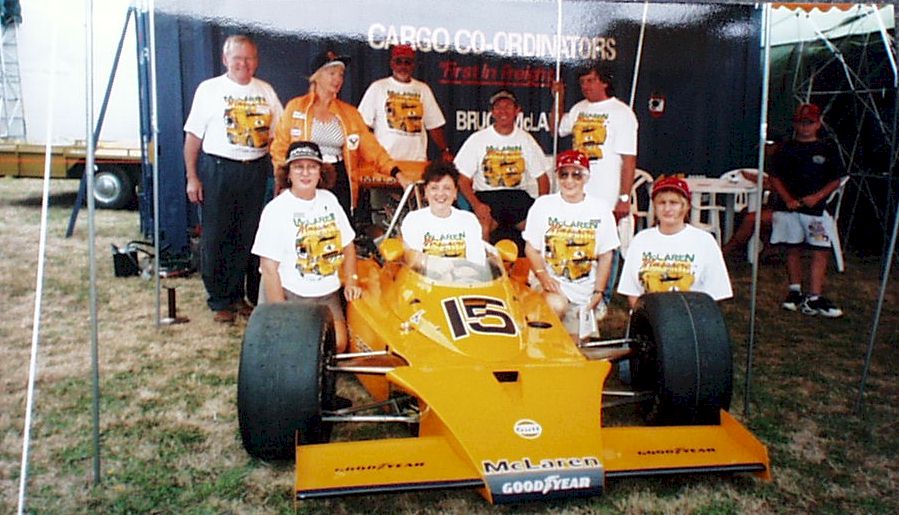 When Fox Roberts Racing imported
the M16 from San Diego in 1997 it had a ‘cooking’ cast iron five litre Chev V8
installed of about 400 bhp. We presumed that the Americans had installed this engine so
that the car could run as a Formula 5000 on the local scene. The suspension set-up and
corner weighting was way out and the fuel cell was perished. After the first demo run at
Whenuapai, we installed a new cell and sorted out the suspension, although the rear still
had some basic problems and we then ran the car at the1998 Formula Libre Grand Prix. At
this point the car had the 10� in clutch and a pull activated slave cylinder which made
gear changing rather slow. The car’s weight without the driver was 1760lbs and this
meant that it was giving away over 300lbs to the F5000s. Driving the car in this condition
was relatively easy because the weight of the car coupled with the large wings and lower
power than the car was built for, made the car very stable. With the big wing on the back
the car stayed ‘glued’ to the track and was predictable with very little
wheelspin, even out of the hairpin. The amount of drag that the car generated, even with
the wings almost flat, meant that it would only do 155mph down the back straight (15 mph
slower than our big block Corvette!) Anyway, we really enjoyed this first race and with
the attrition from accidents and breakdowns we managed to finish 4th at the end of 35
laps, with a best lap time of 1.01.2. The rear anti sway bar mount had come adrift, but
otherwise we could have done another 35 laps. One thing that we have found though, is that
people in New Zealand expect a McLaren of any vintage to be competitive!! When the car
first ran at Indianapolis in Peter Revson’s hands in 1973, it was powered by a 2.6
litre turbocharged Offenhauser engine making about 700 bhp. The car was then raced by Salt
Walther and others through the 70s at Indy and in 1979 was repowered with an aluminium 6.0
litre Chevrolet engine. The M16 then ran at Indy in 1980 and 1981 before being retired.
The options we had were to either seek out an Offenhauser or go the stock block option.
The aluminium 355 cu in stock block option was available from 1972 and would therefore be
period correct as an option for the car. The availability of the Chev engines and the fact
that the turbo lag on the Offenhauser would make the car difficult to drive on a non oval
circuit swayed us towards the Chevrolet option. As luck would have it, an aluminium 355 cu
in V8 was for sale shortly after we had run the car at Manfeild and we decided to purchase
it. At the same time as installing the engine it was appropriate to also tidy up the
clutch, rear sway bar mount, engine mounting brackets, dry sump tank leak, rear wing mount
and general plumbing problems that the car had. The installation and general sorting out
took longer than anticipated and we had the M16 only just completed before the Formula
Libre GP of 1999. On the Thursday before the race I drove the car around for 20 laps at
4,000 revs to run in the new crown wheel and pinion and bed the brake pads. All the
temperatures were good and just as I went out again to try the car for speed, the battery
went flat! Arrived at the track on Saturday, really looking forward to the drive, although
a little apprehensive. The M16 had now shed 200lbs of excess cast iron ( it now weighed
1540 lbs ) and had just over 700 bhp. I asked Duncan to set the car up with a fair amount
of wing downforce as I was not sure how it would be to drive. Initially leaving the pits,
the car felt much more lively, with an urgency it certainly had not had before! Sweeping
through Champion’s big curve and the esses the car felt great and much more balanced
than with the previous heavy load in the back. Within a few laps we were well under the
old lap times and once the tyres were hot and the car was straight, the acceleration was
incredible, especially down the back straight where the M16 was now touching 185 mph. I
only used 1st gear out of the hairpin once because the acceleration was so brutal I
thought that the old car might break something. This is one thing you have to keep in mind
when you are driving this car. It is over 25yrs old, a genuine works car with a long
history and probably worth more than me, so it’s not expendable and you have to drive
within yourself. For the last practice on Sunday morning we eased the wings back for less
downforce and I went out behind Graham Cameron. I guess Graham acted as a "hare"
for me, as the first lap was in the 60’s, then 59 seconds, 58 seconds, 57 seconds and
then 3 laps in the 56’s. Unfortunately engine problems plagued us in the race and
forced our retirement after 10 laps. However, he team was well pleased with the cars
improved performance as it now brings it to comparable performance with the top F5000s in
New Zealand. The responsibilities we have to preserve this car and the other old McLaren
cars were brought home to me in no uncertain terms by a few spins whilst trying to rapidly
warm up the tyres at Manfeild last November. To this end, McLaren International kindly
dispatched a set of old tyre warmers for use on the cars - with the warning - just
don’t let the driver get too enthusiastic straight out of the pits! For next season
starting at Manfeild in November, the engine will be rebuilt and slightly detuned to
650bhp. We hope to get in some practice track time to improve performance and we are
intending to do the Ruapuna and Wigram meetings and possibly Teretonga in early 2000. When Fox Roberts Racing imported
the M16 from San Diego in 1997 it had a ‘cooking’ cast iron five litre Chev V8
installed of about 400 bhp. We presumed that the Americans had installed this engine so
that the car could run as a Formula 5000 on the local scene. The suspension set-up and
corner weighting was way out and the fuel cell was perished. After the first demo run at
Whenuapai, we installed a new cell and sorted out the suspension, although the rear still
had some basic problems and we then ran the car at the1998 Formula Libre Grand Prix. At
this point the car had the 10� in clutch and a pull activated slave cylinder which made
gear changing rather slow. The car’s weight without the driver was 1760lbs and this
meant that it was giving away over 300lbs to the F5000s. Driving the car in this condition
was relatively easy because the weight of the car coupled with the large wings and lower
power than the car was built for, made the car very stable. With the big wing on the back
the car stayed ‘glued’ to the track and was predictable with very little
wheelspin, even out of the hairpin. The amount of drag that the car generated, even with
the wings almost flat, meant that it would only do 155mph down the back straight (15 mph
slower than our big block Corvette!) Anyway, we really enjoyed this first race and with
the attrition from accidents and breakdowns we managed to finish 4th at the end of 35
laps, with a best lap time of 1.01.2. The rear anti sway bar mount had come adrift, but
otherwise we could have done another 35 laps. One thing that we have found though, is that
people in New Zealand expect a McLaren of any vintage to be competitive!! When the car
first ran at Indianapolis in Peter Revson’s hands in 1973, it was powered by a 2.6
litre turbocharged Offenhauser engine making about 700 bhp. The car was then raced by Salt
Walther and others through the 70s at Indy and in 1979 was repowered with an aluminium 6.0
litre Chevrolet engine. The M16 then ran at Indy in 1980 and 1981 before being retired.
The options we had were to either seek out an Offenhauser or go the stock block option.
The aluminium 355 cu in stock block option was available from 1972 and would therefore be
period correct as an option for the car. The availability of the Chev engines and the fact
that the turbo lag on the Offenhauser would make the car difficult to drive on a non oval
circuit swayed us towards the Chevrolet option. As luck would have it, an aluminium 355 cu
in V8 was for sale shortly after we had run the car at Manfeild and we decided to purchase
it. At the same time as installing the engine it was appropriate to also tidy up the
clutch, rear sway bar mount, engine mounting brackets, dry sump tank leak, rear wing mount
and general plumbing problems that the car had. The installation and general sorting out
took longer than anticipated and we had the M16 only just completed before the Formula
Libre GP of 1999. On the Thursday before the race I drove the car around for 20 laps at
4,000 revs to run in the new crown wheel and pinion and bed the brake pads. All the
temperatures were good and just as I went out again to try the car for speed, the battery
went flat! Arrived at the track on Saturday, really looking forward to the drive, although
a little apprehensive. The M16 had now shed 200lbs of excess cast iron ( it now weighed
1540 lbs ) and had just over 700 bhp. I asked Duncan to set the car up with a fair amount
of wing downforce as I was not sure how it would be to drive. Initially leaving the pits,
the car felt much more lively, with an urgency it certainly had not had before! Sweeping
through Champion’s big curve and the esses the car felt great and much more balanced
than with the previous heavy load in the back. Within a few laps we were well under the
old lap times and once the tyres were hot and the car was straight, the acceleration was
incredible, especially down the back straight where the M16 was now touching 185 mph. I
only used 1st gear out of the hairpin once because the acceleration was so brutal I
thought that the old car might break something. This is one thing you have to keep in mind
when you are driving this car. It is over 25yrs old, a genuine works car with a long
history and probably worth more than me, so it’s not expendable and you have to drive
within yourself. For the last practice on Sunday morning we eased the wings back for less
downforce and I went out behind Graham Cameron. I guess Graham acted as a "hare"
for me, as the first lap was in the 60’s, then 59 seconds, 58 seconds, 57 seconds and
then 3 laps in the 56’s. Unfortunately engine problems plagued us in the race and
forced our retirement after 10 laps. However, he team was well pleased with the cars
improved performance as it now brings it to comparable performance with the top F5000s in
New Zealand. The responsibilities we have to preserve this car and the other old McLaren
cars were brought home to me in no uncertain terms by a few spins whilst trying to rapidly
warm up the tyres at Manfeild last November. To this end, McLaren International kindly
dispatched a set of old tyre warmers for use on the cars - with the warning - just
don’t let the driver get too enthusiastic straight out of the pits! For next season
starting at Manfeild in November, the engine will be rebuilt and slightly detuned to
650bhp. We hope to get in some practice track time to improve performance and we are
intending to do the Ruapuna and Wigram meetings and possibly Teretonga in early 2000.
Today, the pair are running Group 7 Sportscars Ltd, dedicated to
building and supply rebuilt and new parts for McLaren Cars. |
