McLaren Formula 1 |
||
Formula One – hard and unforgiving |
||
It was a great raucous lump of a power unit, topped by Hilborn fuel injection intake trumpets which would do credit to the ventilators on an ocean liner, and tailed by high-level ‘snake-pit’ exhausts straight from a Royal Artillery arsenal… |
||
 The McLaren marque made its
Formula One debut on May 22, 1966, in the Monaco Grand Prix, Bruce McLaren lined up his
little team’s ‘Mallite" monocoque car – M2B chassis ‘2’
– on tenth-fastest spot on the starting grid. This chunky Robin Herd-designed
challenger packed a hefty engine in its rear bay, an Indy Ford 4-cam V8 reduced from its
Speedway-standard 4.2 litres capacity to the contemporary Formula One limit of 3-litres.
It was a great raucous lump of a power unit, topped by Hilborn fuel injection intake
trumpets which would do credit to the ventilators on an ocean liner, and tailed by
high-level ‘snake-pit’ exhausts straight from a Royal Artillery arsenal… The McLaren marque made its
Formula One debut on May 22, 1966, in the Monaco Grand Prix, Bruce McLaren lined up his
little team’s ‘Mallite" monocoque car – M2B chassis ‘2’
– on tenth-fastest spot on the starting grid. This chunky Robin Herd-designed
challenger packed a hefty engine in its rear bay, an Indy Ford 4-cam V8 reduced from its
Speedway-standard 4.2 litres capacity to the contemporary Formula One limit of 3-litres.
It was a great raucous lump of a power unit, topped by Hilborn fuel injection intake
trumpets which would do credit to the ventilators on an ocean liner, and tailed by
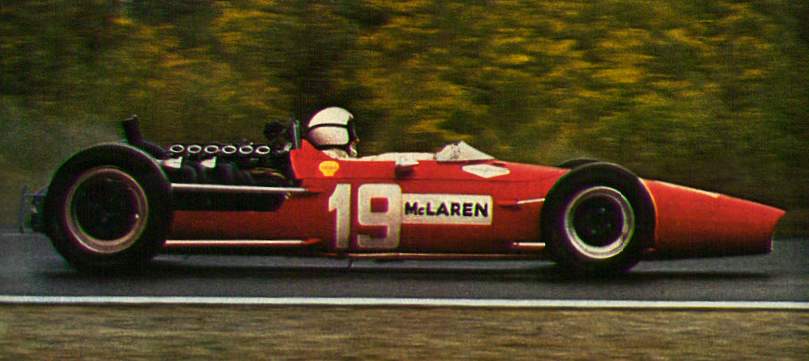
high-level ‘snake-pit’ exhausts straight from a Royal Artillery arsenal…Bruce admitted that the engine’s greatest success was in being by far the noisiest thing running round Monte Carlo, and the raucous echoes it set up between the cake-icing buildings of the old town threatened not only the occupants’ eardrums but their window panes. Unfortunately this maiden McLaren Formula One race ended not in success but after nine slowish laps with an oil leak into the cockpit and onto the road. The little McLaren Team – headed by Bruce himself, Teddy Mayer and Tyler Alexander – realised that their modified Ford engine was over-ported, delivering barely 300 horsepower across a painfully narrow rev band, to which its four-speed GT40-type ZF gearbox was poorly suited. Bruce admitted immediately: "we’re going to have to make some fairly drastic moves in the engine room…" He found a stand-in power unit in the neat shape of Count
Volpi’s new Serenissima V8, made in Italy to a design by Ing. Alberto Massimino whose
previous credits included the Lancia-Ferraris of 1956-57 and the front engined classic
Maserati 250F GP cars. Serenissima had just launched this carburetted V8 as a sports car
engine, but Count Volpi now fancied F1 exposure. McLaren just needed a workable engine.
The race M2B chassis’ rear engine-bay horns were modified to accommodate this Italian
unit’s low-level side exhausts in contrast to the centre-exhaust Ford for which it
had been tailor-made, and with little more than 260 horsepower Bruce took the reassembled
machine to the Belgian GP, at Spa. Formula One racing was as hard and unforgiving then as
it is now. After refusing for hours to start and run cleanly during practice, the new V8
finally ran its bearings after its first exploratory half lap. With no spare there was no
alternative but to non-start. At Zandvoort the following weekend for the Dutch GP the Serenissima engine failed, causing another non-start, and thereafter the F1 programme was set aside pending adequate development of the 3-litre Indy Ford V8 engine. It re-emerged in the test-prototype M2B – chassis ‘1’ – in the lucrative United States G at Watkins Glen, and there Bruce finished fifth by surviving another rate of attrition – McLaren Motor Racing’s second two points were in the bag. But mechanical disaster then followed in the season-ending Mexican GP, as the engine disintegrated after 40 race laps … Bruce studied alternatives for 1967, and became BRM’s first customer for a Formula One version of a new 2-cam V12 engine they were developing primarily for sports car racing. A new McLaren M5A monocoque chassis design was laid down for this engine, but BRM would plainly be late in delivery so for the interim a little F1 hybrid works McLaren was built up instead. This car – the McLaren BRM M4B – was based upon a
Formula 2 production design intended for the new 1600cc Formula 2 class then poised for
launch in ’67. An initial batch of ten of these basic Cosworth FVA 4 cylinder engined
F2/Formula B cars were being laid down by Lambretta-Trojan as part of their production
agreement with the McLaren team. Now the works F1 hybrid car for early ’67 was
produced by modifying its rear bay to accept a 2.1 litre Tasman BRM V8 engine, delivering
around 280 bhp – fitting long range pannier fuel tanks to provide GP distance range
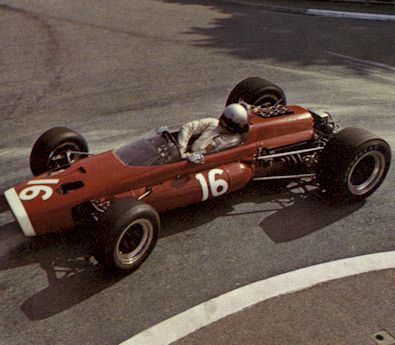
– and then ballasting the reassembled little car to meet the minimum weight. This handsomely compact single-seater was then finished in the team’s brick-red sports car livery. Bruce and Teddy Mayer were continually changing their minds about the right colour for their cars as you will see on these pages. The 1966 F1 car had been painted white with a green stripe, partly as a distinctive stand-in for the Phantom ‘Nomura’ F1` car required by MGM who were filming John Frankenheimer’s ‘Grand Prix’ epic around the circuits. Now the new McLaren M4B was to be a rich red and in this livery it made its debut – Bruce driving – in the Race of Champions at Brands Hatch, finished fourth in Heat One but then its engine broke due to a missed gear in Heat Two. Fifth places then followed in two more of the traditional non-Championship season opening F1 races at Oulton Park and Silverstone, and then to Monaco. There, the little M4B was just about tailor-made for the tight street circuit, and but for its battery running flat – forcing a dramatic pit stop – Bruce could well have finished second behind fellow Kiwi Denny Hulme’s victorious Repco Brabham. Some of the spirit of Formula One in those days is typified by the pit stop as Bruce believed his misfire problem was fuel pressure and bawled as much at the crew. But Jack Brabham – a rival of course but out of the race by that time – had come into the pit and he was shouting "It’s your battery – it’s your battery!" As Bruce wrote "Good old Jack. It was the battery and we quickly whipped another one on …" He rejoined and finished fourth – three further Championship points … thanks in part to a rival team chief! Unfortunately, the M4B was then badly damaged on lap 2 of the Dutch GP at Zandvoort as Bruce went off on spilled oil in the fast Huzaren Viak corner. After the damage had been repaired he was testing the M4B at Goodwood when it caught fire out on the circuit, and he could do little other than watch it burn to the waterline. The McLaren team’s first forays into Formula One had shown promise, had accumulated six World Championship points, but left great room for improvement. And that would surely come … Reprinted from Racing Line August 1997 Notes: The interim F2-based BRM-powered car (the M4) and one-off BRM V12 (M5) kept the team in F1 before they gained access to the Ford Cosworth DFV. With the M7 the team made leaps and bounds and became a force to be reckoned with in the F1 community. The first GP win for the team came in 1968 when Bruce McLaren won the Belgian GP at the wheel of the Ford-Cosworth powered M7A racing car. |
||
 Bruce and his young intended team-mate Chris
Amon then had the joy of victory for Ford at Le Mans, but an F1 entry in the French GP at
Rheims was scratched before the lone M2B-Serenissima reappeared in the British event at
Brands Hatch. This time the Italian V8 proved reliable. The race started on a damp track
and Bruce – on wet weather tyres – made a superb start and ran briefly in the
top six on merit. As the road dried he dropped back, but then profited from retirements to
inherit sixth place at the finish – scoring his new McLaren marque’s first World
Championship point.
Bruce and his young intended team-mate Chris
Amon then had the joy of victory for Ford at Le Mans, but an F1 entry in the French GP at
Rheims was scratched before the lone M2B-Serenissima reappeared in the British event at
Brands Hatch. This time the Italian V8 proved reliable. The race started on a damp track
and Bruce – on wet weather tyres – made a superb start and ran briefly in the
top six on merit. As the road dried he dropped back, but then profited from retirements to
inherit sixth place at the finish – scoring his new McLaren marque’s first World
Championship point.