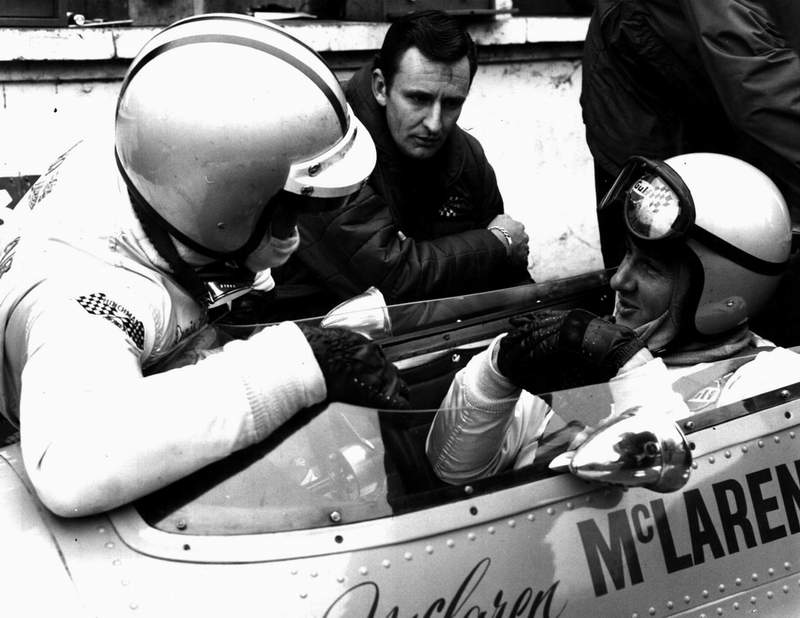
 One of the most successful teams in the 60's in motor racing was
Bruce McLaren’s. They specialised in the rich Can Am series with great success,
winning the series and a great deal of money, five years in succession, as well as
building many replicas of their winning sports cars. However, they did not neglect the
Formula 1 field entirely, although the bulk of their attention was naturally been directed
towards the sports car programme. Having used a BRM engine unsuccessfully in 1967 they
joined the Ford bandwagon in 1968, designing a new car, the M7A, to take the Ford engine.
They had a reasonably successful season despite being dogged by a lot of transmission
trouble, Denny Hulme winning the Italian and Canadian Gp's while Bruce won the Belgian,
leaving them third and fifth respectively in the World Championship. The design was
retained for 1969 but in addition two new cars were brought into service, the M7C, which
is in fact an adaptation of the Formula 5000 M10, and the M9A which is a completely new
four wheel drive car. One of the most successful teams in the 60's in motor racing was
Bruce McLaren’s. They specialised in the rich Can Am series with great success,
winning the series and a great deal of money, five years in succession, as well as
building many replicas of their winning sports cars. However, they did not neglect the
Formula 1 field entirely, although the bulk of their attention was naturally been directed
towards the sports car programme. Having used a BRM engine unsuccessfully in 1967 they
joined the Ford bandwagon in 1968, designing a new car, the M7A, to take the Ford engine.
They had a reasonably successful season despite being dogged by a lot of transmission
trouble, Denny Hulme winning the Italian and Canadian Gp's while Bruce won the Belgian,
leaving them third and fifth respectively in the World Championship. The design was
retained for 1969 but in addition two new cars were brought into service, the M7C, which
is in fact an adaptation of the Formula 5000 M10, and the M9A which is a completely new
four wheel drive car.
The M7A followed the design trend set by Lotus in 1967 of
having the engine as a load bearing part of the chassis, so that the chassis as such
terminated immediately behind the driver’s shoulders, the engine being slotted into
place as part of the chassis, taking most of the rear suspension loads. Since the engine
was designed from the outset to be an integral part of the chassis this was an obvious
step to take, since it saved weight. The chassis is a fairly simple monocoque with long
side pontoons running the full length of the chassis; these are made from 20 and 22 gauge
aluminium alloy and are joined by three sheet steel fabricated bulkheads which impart a
great deal of strength. These side boxes hold the rubber fuel bag tanks, which, together
with a scuttle mounted tank, can take up to 40 gallons of fuel. For 1969, an external side
tank was used at times, giving a capacity of 47 gallons. followed the design trend set by Lotus in 1967 of
having the engine as a load bearing part of the chassis, so that the chassis as such
terminated immediately behind the driver’s shoulders, the engine being slotted into
place as part of the chassis, taking most of the rear suspension loads. Since the engine
was designed from the outset to be an integral part of the chassis this was an obvious
step to take, since it saved weight. The chassis is a fairly simple monocoque with long
side pontoons running the full length of the chassis; these are made from 20 and 22 gauge
aluminium alloy and are joined by three sheet steel fabricated bulkheads which impart a
great deal of strength. These side boxes hold the rubber fuel bag tanks, which, together
with a scuttle mounted tank, can take up to 40 gallons of fuel. For 1969, an external side
tank was used at times, giving a capacity of 47 gallons.
Front suspension is by double wish-bones,
but with very wide based rear arms, which are virtually radius rods. The rearmost ends of
these are mounted on the steel bulkhead. Armstrong coil spring/damper units are fitted as
is an anti-roll bar. Steering is by McLaren made rack and pinion, the front up rights
being magnesium castings, with separate steering arms.
Surprising as it may seem, the engine is
attached to the chassis by means of four bolts, two at the top on extension plates from
the cam covers of the engine and two at the bottom extending from lugs cast on to the
crankcase. Despite the apparent fragility of this arrangement it has never given any
trouble and the car has never fallen in half! This means that the only attachment the rear
suspension has with the chassis is through the four radius arms which run forward from the
rear suspension and bolt to the final steel bulkhead behind the cockpit. The rear
suspension is conventional by current standards, having single top links, reversed lower
wishbones and twin radius arms each side. Armstrong coil spring/damper units are fitted as
at the front. Most of the suspension loads at the back are taken by the gearbox through a
box section steel yoke which is bolted to the top of the gearbox, while the lower
suspension arms mount on a magnesium plate bolted to the base of the gearbox. The gearbox
is a five speed Hewland DG300 with a Borg and Beck twin plate diaphragm clutch, the drive
being taken to the wheels via BRD frictionless roller splined shafts. Braking is by
Lockheed ventilated discs, the discs being of 11.6in diameter. Cast magnesium 15in
diameter wheels are used with varying rim widths, usually 11 or 12in at the front and 15
or 16in at the rear.
As they were pinning a lot of their hopes
on the 4wd car the McLaren team did not design a new 2wd car for 1969 but they did do one
or two experiments with existing cars. For the South African GP at the start of the season
Bruce McLaren’s M7A was fitted with pannier fuel tanks, which were mounted low down
on the sides of the chassis, to assist in improving weight distribution as well a
providing extra fuel capacity as already mentioned.
 He used the M7B, as it become known, for a while
then sold it to Colin Crabbe who entered it for Formula 1 races for Vic Elford to drive.
To replace this car Bruce McLaren built a Formula 1 version of the M10 car which was used
in Formula 5000 races. This is a monocoque very similar to the M7A but since it is
intended for a variety of big American V8 engines it has an extension of the monocoque to
support the engine. This is a monocoque very similar to the M7A but since it is intended
for a variety of big American V8 engines it has an extension of the monocoque to support
the engine. This was deleted for the Formula 1 car and the same method of attachment used
as on the M7A. The monocoque differs mainly in that it is swept back and upwards alongside
the cockpit to form an integral roll-over bar behind the driver’s head, thus
strengthening the chassis. Mechanically the car is much the same as the M7A, using the
same suspension components although modifications were made to the suspension geometry. It
started off with 15in wheels but a switch was made to 12in front wheels, which meant a
reduction in front brake size rim 11.11in to 10.5in. It ran in this form for most of the
season, the only other major change being the addition of a small pannier tank for the
longer races. He used the M7B, as it become known, for a while
then sold it to Colin Crabbe who entered it for Formula 1 races for Vic Elford to drive.
To replace this car Bruce McLaren built a Formula 1 version of the M10 car which was used
in Formula 5000 races. This is a monocoque very similar to the M7A but since it is
intended for a variety of big American V8 engines it has an extension of the monocoque to
support the engine. This is a monocoque very similar to the M7A but since it is intended
for a variety of big American V8 engines it has an extension of the monocoque to support
the engine. This was deleted for the Formula 1 car and the same method of attachment used
as on the M7A. The monocoque differs mainly in that it is swept back and upwards alongside
the cockpit to form an integral roll-over bar behind the driver’s head, thus
strengthening the chassis. Mechanically the car is much the same as the M7A, using the
same suspension components although modifications were made to the suspension geometry. It
started off with 15in wheels but a switch was made to 12in front wheels, which meant a
reduction in front brake size rim 11.11in to 10.5in. It ran in this form for most of the
season, the only other major change being the addition of a small pannier tank for the
longer races.
The M7A and M7C were raced by the McLaren
team throughout 1969 as the new 4wd car did not come up to expectations, and it only went
to one race. The M9A uses a relatively conventional chassis, with two large D shaped side
pontoons joined by a stressed floor and three steel bulkheads, exactly as on the M7A,
although the actual design is very different. To cope with the fuel consumption of the
latest 9 series Cosworth engine (about 4-5mpg) the pontoons which contain the 5 Goodyear
rubber fuel cells have been enlarged so that the car can carry 47 gallons of fuel without
the need for additional tanks. The chassis terminates behind the driver’s cockpit
just as on the M7A, and the engine is used as an integral part of the chassis, but it is
turned back to front with the McLaren designed, Hewland built, five speed gearbox mounted
at the front. The drive is taken across to the left of the chassis to a very compact
epicyclic centre differential which is an extension of the gearbox. The drive passes
forward and rearwards to the chassis mounted Hewland/ZF limited slip differentials which
drive to the wheels via McLaren designed shafts each having a pair of Hardy Spicer
constant velocity joints. The rear differential is mounted in a fabricated tube and sheet
steel box which is bolted to the back of the engine.
Suspension is very different from the M7A
because both inboard suspension and inboard brakes are used, although outboard front
brakes can be fitted as Bruce McLaren is worried about the possible effect if a front
drive shaft broke. The front suspension utilises a wide based wishbone, the upper leading
arm working on the cantilever principle, being angled forward to operate the vertically
mounted Armstrong coil spring/damper unit. At the rear, the coil spring/damper units are
mounted right at the rearmost extremity of the car in a rather vulnerable position, being
operated by the trailing arm of the upper wishbone. The bottom wishbone is triangulated
and is also anchored to the engine crankcase by means of a long radius rod. The Girling
brakes with callipers mounted at the bottom of the disc are of 11�in diameter, while 13in
McLaren-designed magnesium wheels are used with rims available ranging from 11in to 16in
in diameter. At 1,250lb dry weight the M9A weighs about 20lb more than the M7A which is
quite an achievement. Since aerofoils were restricted before the M9A appeared it merely
has a pair of stub wings on the nose and a large ‘tray’ over the engine which is
part of the bodywork and is therefore admissible as an aerodynamic aid.
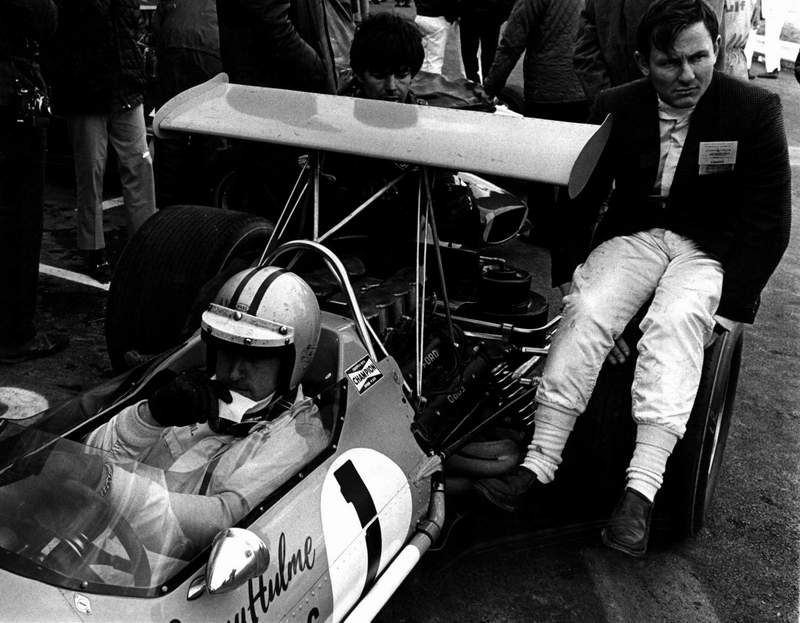 The McLaren team had a very satisfactory 1969 season considering that the
cars they used most of the time were basically a year old, while the M7A dated back two
years in its design. The season started in South Africa where both Bruce McLaren and Denny
Hulme had M7As; they finished in creditable places, Denny third and Bruce fifth in the
side tank car. With the same cars at the Race of Champions at Brands Hatch Denny Hulme
finished third, while Bruce retired with ignition bothers. The M7C appeared at the
Silverstone Race of Champions, Bruce taking this car into sixth place while Denny retired
the M7A with a blow engine. From then on until the end of the season the two team drivers
retained the same cars, notching up quite a few good placing’s. In the Spanish GP
Bruce finished second and Denny fourth, at Monaco Bruce with fifth and Denny sixth, in the
Dutch GP Denny was fourth while Bruce retired with suspension trouble. Vic Elford now had
Bruce’s old M7B and finished tenth. In the French GP, Bruce was fourth, Vic Elford
fifth and Denny eighth after a pit stop with a broken anti-roll bar bolt. The McLaren team had a very satisfactory 1969 season considering that the
cars they used most of the time were basically a year old, while the M7A dated back two
years in its design. The season started in South Africa where both Bruce McLaren and Denny
Hulme had M7As; they finished in creditable places, Denny third and Bruce fifth in the
side tank car. With the same cars at the Race of Champions at Brands Hatch Denny Hulme
finished third, while Bruce retired with ignition bothers. The M7C appeared at the
Silverstone Race of Champions, Bruce taking this car into sixth place while Denny retired
the M7A with a blow engine. From then on until the end of the season the two team drivers
retained the same cars, notching up quite a few good placing’s. In the Spanish GP
Bruce finished second and Denny fourth, at Monaco Bruce with fifth and Denny sixth, in the
Dutch GP Denny was fourth while Bruce retired with suspension trouble. Vic Elford now had
Bruce’s old M7B and finished tenth. In the French GP, Bruce was fourth, Vic Elford
fifth and Denny eighth after a pit stop with a broken anti-roll bar bolt.
No less than four McLarens appeared in the British GP, the M9A making its one and only
appearance in 1969 in the hands of Derek Bell but it suffered a puncture in the fifth lap, which broke
a rear hub carrier. The old cars soldiered on, Bruce finishing third, and Elford sixth
while Denny retired with a broken camshaft. In the German GP Bruce again finished third,
Denny retired with gearbox trouble while poor Vic Elford hit the wreckage of a crashed
Lotus and crashed, breaking his arm and putting the car out of action for the rest of the
season. In the Italian GP at Monza Bruce finished fourth and Denny seventh while in Canada
Bruce was fifth and Denny retired with electrical bothers. Both cars fell out of the
American GP, Bruce before the race started with a blown engine and Denny with gear
selector problems. hands of Derek Bell but it suffered a puncture in the fifth lap, which broke
a rear hub carrier. The old cars soldiered on, Bruce finishing third, and Elford sixth
while Denny retired with a broken camshaft. In the German GP Bruce again finished third,
Denny retired with gearbox trouble while poor Vic Elford hit the wreckage of a crashed
Lotus and crashed, breaking his arm and putting the car out of action for the rest of the
season. In the Italian GP at Monza Bruce finished fourth and Denny seventh while in Canada
Bruce was fifth and Denny retired with electrical bothers. Both cars fell out of the
American GP, Bruce before the race started with a blown engine and Denny with gear
selector problems.
Finally they wound up the season with
victory, Denny winning the Mexican GP after a long tough battle, but Bruce once again
non-started when a piece of metal jammed the fuel pressure relief valve. But he was happy
enough to sit back and watch his team’s first F1 win of the season. |
