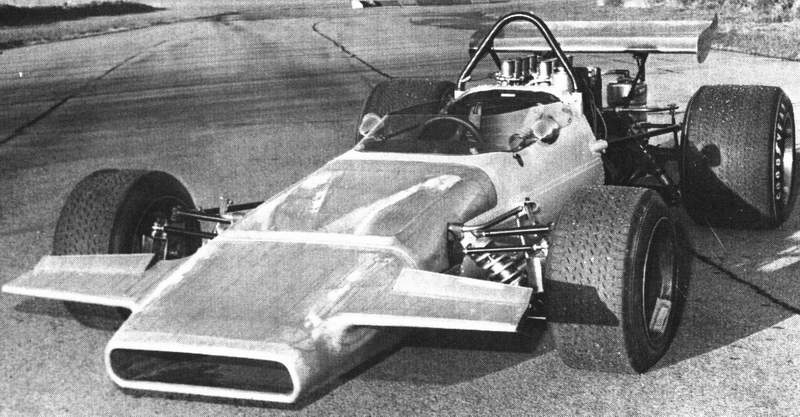
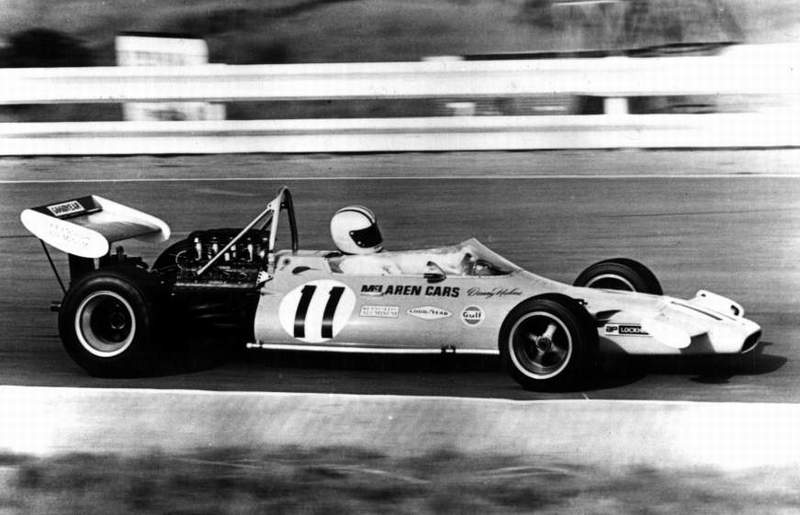
| McLaren
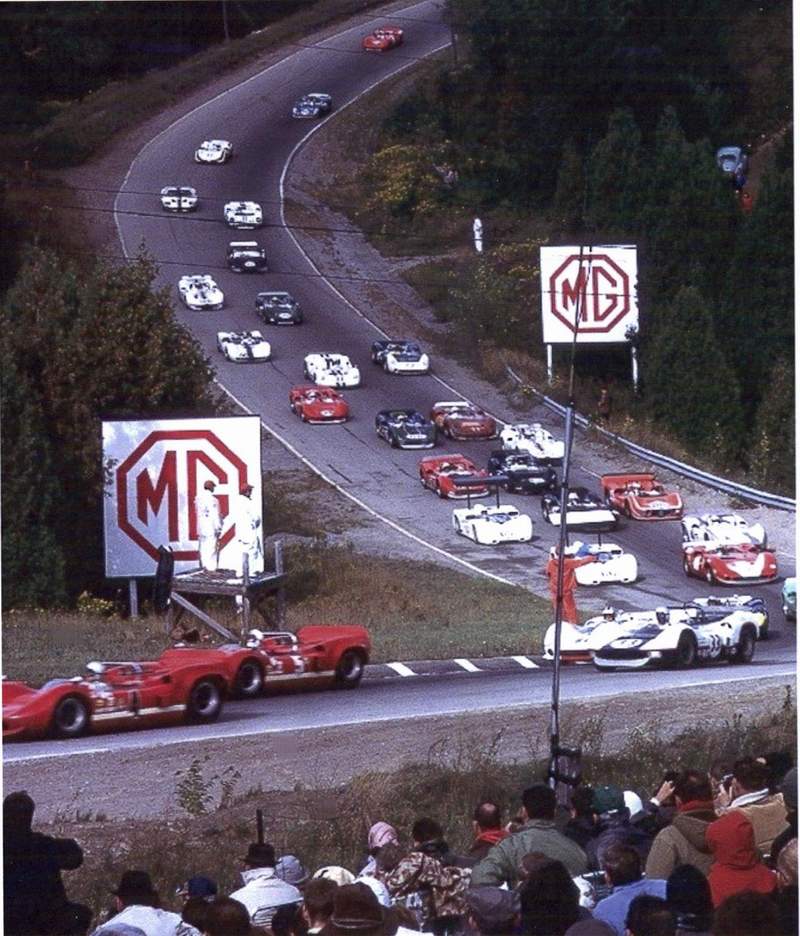
"Zerex" This was Bruce's first race car for the American series. The chassis was built in the UK and was based on rebuilding from just behind the front suspension to just ahead of the rear suspension with a new McLaren designed tube frame that was welded in. This chassis was far more stiffer that the willowy Zerex original and it had the sophistication of having the water and oil flowing through the chassis tubes. There was no time to fabricate the new exhaust system and the car was flown to Mosport with eight stub exhausts poking up through the tail. First time out it won at Mosport that year and at Brands hatch at the end of August 1963. The car had three names, one "The Jolly Green Giant" (bought about due to lack of time to finish the car, a handyman's store was visited and a can of garden gate green was obtained), the second name was the "Zerex Special" (re-framed and re-engineered, which the car was more commonly known as) and for various reasons Bruce decreed that the car should be known as the "Cooper Oldsmobile". Officially the car was a Cooper Oldsmobile when Bruce won with it at Mosport in June 1964. The car won another race in the Guards Trophy at Brands Hatch at the end of August that year. |
 |
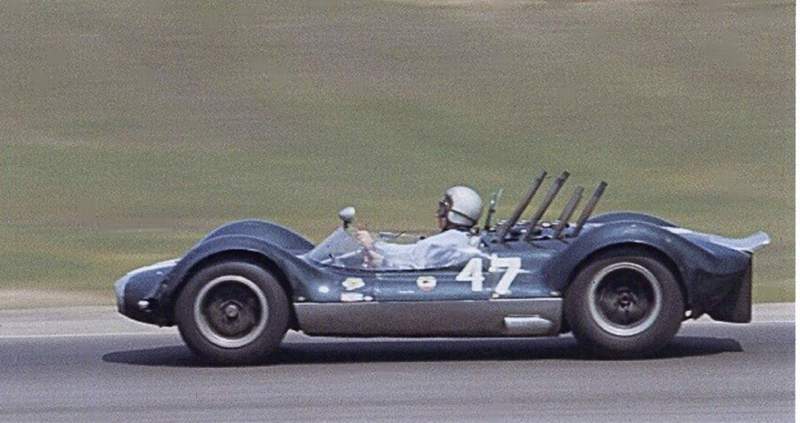 Photo by Don Markle |
|
| M1A
- 1964-65 The original McLaren built Group 7 sports racing car was a simple space frame design with a light and compact Oldsmobile V-8 engine, cooper wheels, uprights and steering arms, and a Hewland Gearbox. Fitted with the engine effort the Zerex, the McLaren M1 lowered the Zerex's records at Goodwood by a clear 3 seconds. The car was painted black with a silver stripe ( New Zealand's colours) and it was the fastest car on the track at Mosport in September, but with a broken throttle linkage and a long pit stop, Bruce came back to finish third. Later on that season at Nassau the car was painted an orange red colour and the car finished second to Roger Penske's Chaparral. In England Frank Nichols of Elva Cars called on Bruce and a long association was formed with Peter Agg of Trojan (Elva's parent company) to build McLaren replicas They were to be called McLaren-Elvas. The M1A was put into production as the McLaren-Elva Mark 1 and versions appeared with 4.7 litre Ford V-8 power in addition to the standard 4.5 litre Olds, A total 24 were built and met with success, although it became apparent that the Olds engine was just too small for the class. Chassis:
Large diameter round and square tubular frame with light alloy sheet riveted and bonded to
it, forming stressed undertray and bulkheads. |
 |
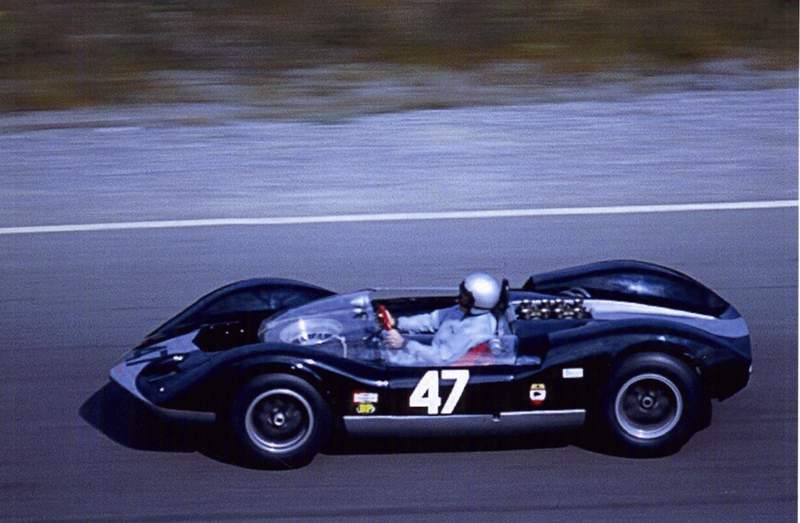 Photo by Don Markle |
|
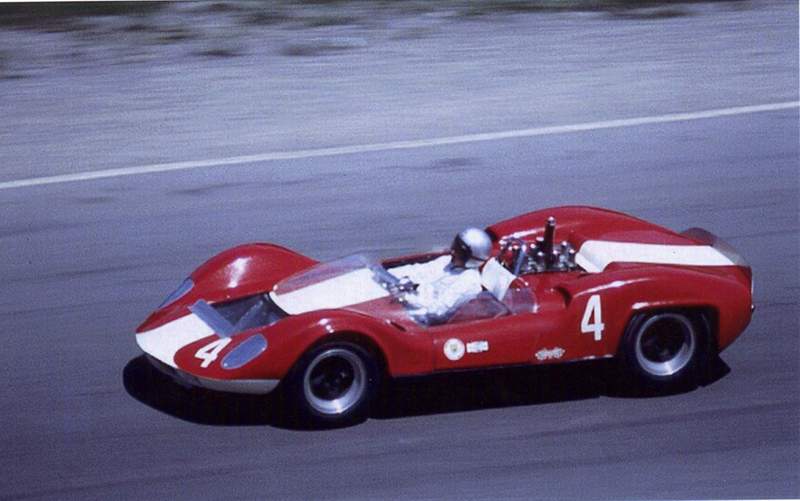 Photo by Don Markle |
|
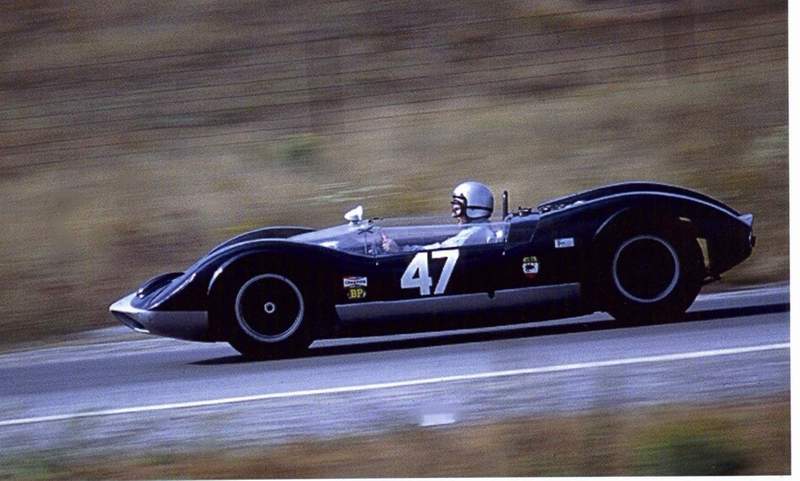
| M1B
- 1965-66 This Group 7 sports racing car was the 1965 development of the original M1A design. The design of the M1B was evolved the by artist Michael Turner, working with Tyler Alexander and Robin Herd. It had a blunter noise and sharper cut off at the tail. Design work by Robin Herd saw the M1B gaining a20% stiffer chassis than the M1A and the M1B was no heavier. The first race was at St Jovite and resulted in an ignominious retirement in practice when the Oldsmobile blew up wrecking the transmission as well. Before Mosport, a new 4.5 litre had arrived from Traco and with this installed Bruce finished second to Jim Halls Chaparral. For the first Can-Am series in 1966 it became obvious to team McLaren early in the season that their 5 Litre Traco-Oldsmobile were going to be no match for the 6 Litre Chevrolet. After the opening races in Canada, Bruce switched from the aluminium engine to the cast iron 5.4 litre Chevrolet which weighed an extra 200 lbs more, but gave an extra 100 horsepower. The works car driven by McLaren and Amon competed in the 1966 Can-Am series powered by the 6 Litre Chevrolet V-8 with Hilborn injection. Both Bruce and Chris were pace setters, but they were not winners, with Bruce finishing second in the series to Jim Surtees. Trojan manufactured twenty-eight cars and were sold in the US as McLaren Elva Mark 11's. Chassis: Large diameter round and square tubular
frame with light alloy sheet riveted and bonded to it, forming undertray and bulkheads. |
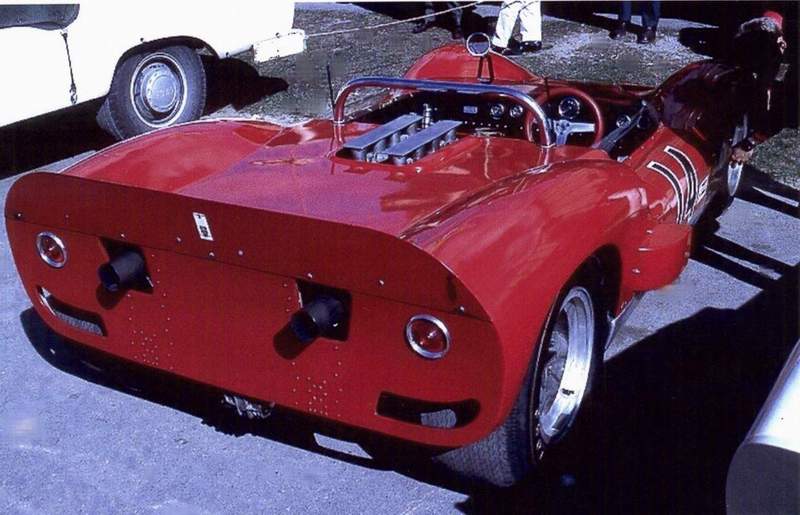 Photo by Don Markle |
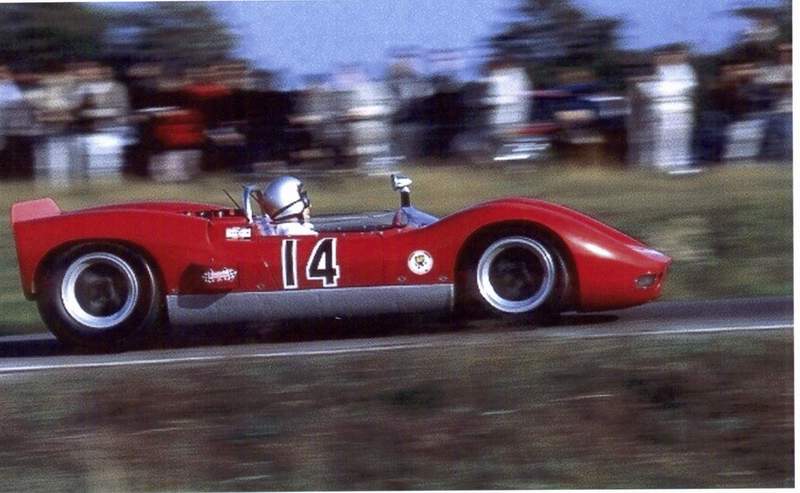 Photo by Don Markle |
|
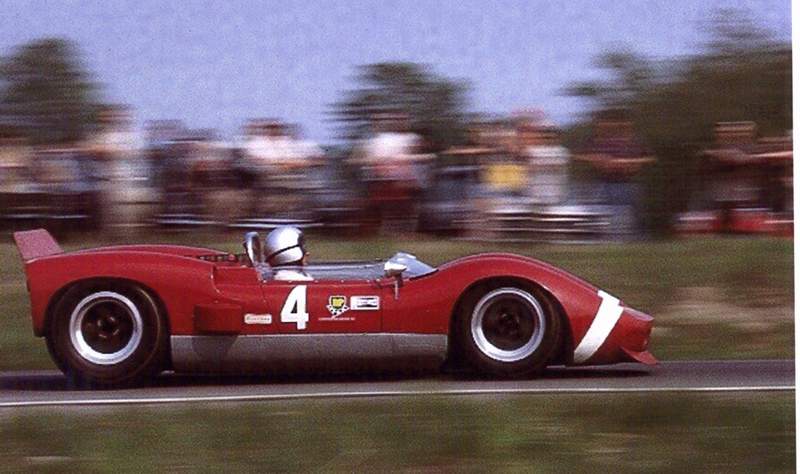 Photo by Don Markle |
|
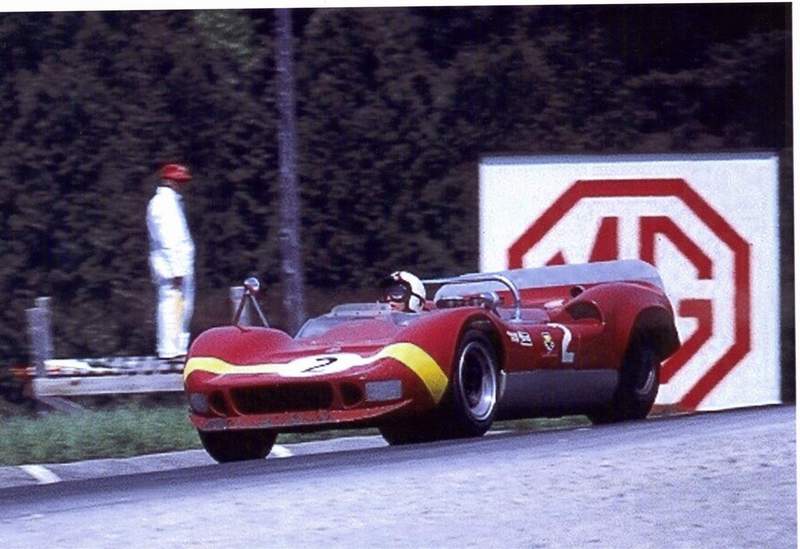 Photo by Don Markle |
|
| M1C
- 1966-67 The M1C was built by Trojan as customer cars, using the space frame design from the original design. These M1C variants, sold as Mark 3s, were generally powered by Chevrolet engines, although Ford or Oldsmobile options were listed. The model was a further improved and developed M1B with a separate spoiler wing at the tail. Twenty-five were built and were sold in the USA as McLaren Elva Mark 3's. Chassis: Large diameter round and square tubular frame with
light alloy sheet riveted and bonded to it, forming undertray and bulkheads. |
|
| M2A - 1965 This was an early exercise in producing a Mallite monocoque and was the teams first single seat design by Robin Herd. The car was the base for development of the Formula 1 car and served Firestone very well as a test vehicle. It used Traco Oldsmobile and Ford V-8 engines. The car was never raced, but many lessons from its testing were incorporated into the M2B. |
|
| M2B
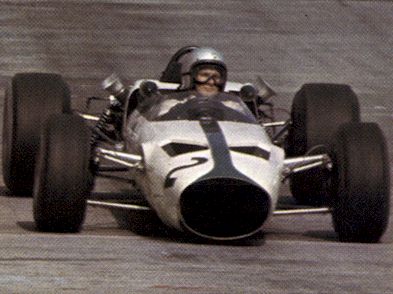
- 1966 This was McLaren Racing's first Formula 1 car. Technically it was a spectacular success, for the chassis was the stiffest open cockpit unit ever built, with torsional rigidity approaching 10,000lbs/ft per degree. The 1966 season was the first to be run under the 3 litre Formula 1, however the McLaren car was not a success and was shelved at the end of the year. two chassis were built, but only one raced. Chassis: Bathtub type monocoque formed from Mallite
and duralumin panelling formed over mild steel bulkheads. |
 |
 |
|
| M3 - 1965-66 The 1965 sports car experiences with the big V-8's, with lightweight chassis led to the design and production of the low cost and reliable space frame single seater for the 1966 Formula Libre, hillclimb/sprintcar. It was competitive and only a handful were built. The M3 was also known as the "whoosh bonk" car and was the MGM camera car for the film Grand Prix. Chassis: Large
diameter tubular spaceframe with steel bulkheads and an aluminium dash panel doubling as a
bulkhead in the cockpit area. Chassis tubes carried coolant and an aluminium undertray was
bonded and riveted in place to add strength |
|
| M4A -1967 In 1967 Robin Herd produced three major design, for Can-Am, Formula 1 and Formula 2. The M4A was a simple monocoque for Formula 2 and raced by Bruce seven times.Some chassis appeared in Formula 3 guise. Piers Courage raced a M4A in the 1968 Tasman Series and gave the M4A its only major victory, it did however prove very popular and won many races in New Zealand. Chassis: Bathtub
monocoque formed from aluminium paneling bonded and riveted to four mild steel bulkheads |
 |
| M4B - 1967 The M4B was the production variant of the Formula 2 design using the Lotus-Ford twincam engines and Hewland HD transaxles for the American Formula B racing. Another so called M4B, the subject of this specification, was the interim 1967 Formula 1 car raced by Bruce McLaren. This was a stop gap measure between the demise of the M2B and the appearance of the new BRM powered M5. The car was also fitted with side sponson to provide extra tankage. Trojan built 25 M4A/B cars in 1967-1968. Chassis:
Bathtub monocoque formed from aluminium paneling bonded and riveted to four mild steel
bulkheads |
|
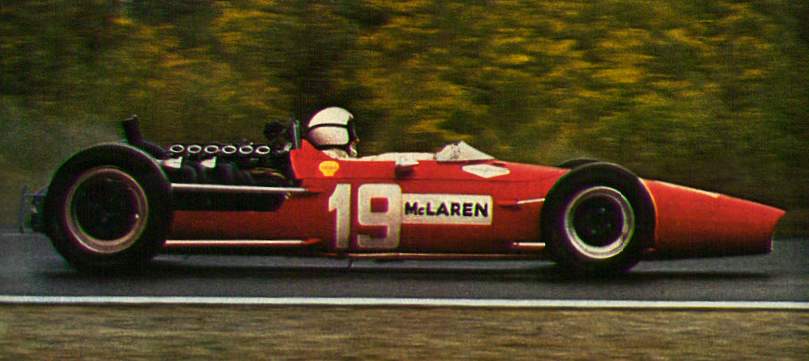
| M5A - 1967-68 The true 1967 McLaren Formula 1 car, the one off M5 was late starter due to delays with its BRM V-12 engine. Its first race was the Canadian GP and was a strong second till the battery had to be replaced during the race Chassis:
Aluminium alloy panelled monocoque formed over mild steel bulkheads with long pontoons at
the rear to support the V-12 engine |
 |
| M6A
- 1967 The first car, M6A-1, was completed and ready for testing at Goodwood on June 19, 1967, more that three months prior to the opening race in the Can-Am series. The car covered over 2000 miles of testing before its debut at Elkhart Lake. Team McLaren won its first Can-Am Series with these cars designed by Bruce, Robin Herd, Don Beresford and Tyler Alexander. It was as simple as possible, consisting of single curvatures and square section tubing wherever they could be used. The M6A was a works car and only three were built. Chassis: Full monocoque
formed from aluminium alloy panelling bonded and riveted to steel bulkheads and carrying
two 25 gallon fuel cells in the side pontoons. |
 Photo by Don Markle |
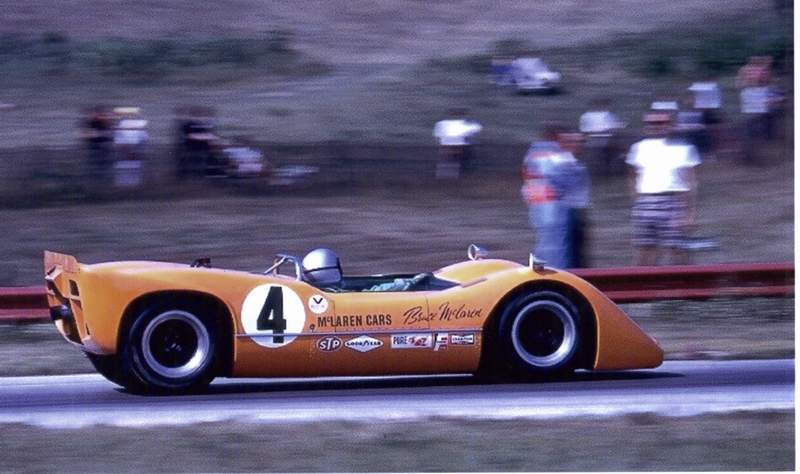 Photo by Don Markle |
|
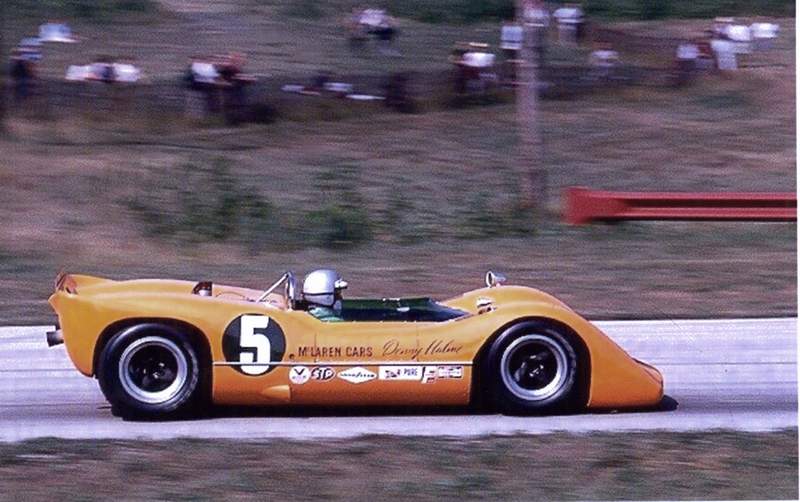 Photo by Don Markle |
|
| M6B -1968 The M6B was the production version of the Championship winning M6A and differed very little from the original. It was built by Trojan and was offered in a rolling chassis complete waiting only for a motor to be fitted. It was in tremendous demand and a total of twenty-eight were built and their specifications where virtually identical to those of the M6A. |
|
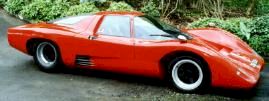
| M6GT - 1969 Following the successes of the M6 series in Group 7, a Group 4 GT model was projected for the 69 series. Unfortunately the type met with various problems preventing its homologation in its class and the project was shelved after 4 examples had been completed. One was completed as a road car for Bruce to test as a prototype for a road car series bearing his name. |
|
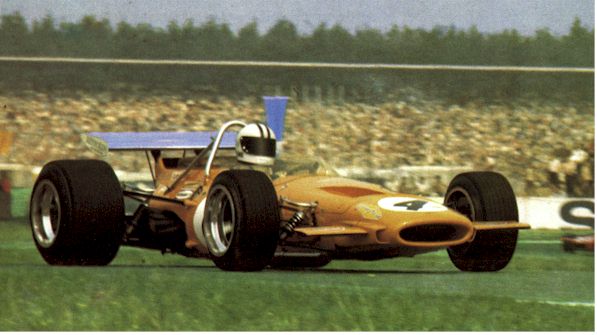
| M7A
- 1968-69 Robin Herd had a guiding hand with the design of the M7A, it was the teams first Cosworth-Ford powered Formula 1 car. Three M7A's were built to be driven by Bruce and Denny Hulme, the third was the team's spare. This was Robin Herd's first McLaren design and in the interests of accessibility, they had bathtub type monocoque which terminated behind the rear cockpit bulkhead, using the engines crankcase as a fully stressed rear chassis member. Chassis: Monocoque
with light aluminium alloy panelling over steel bulkheads, using the engine as a stressed
section aft of the cockpit, carrying rear suspension loads through a yoke over the gearbox
and plates bolted beneath it. |
 |
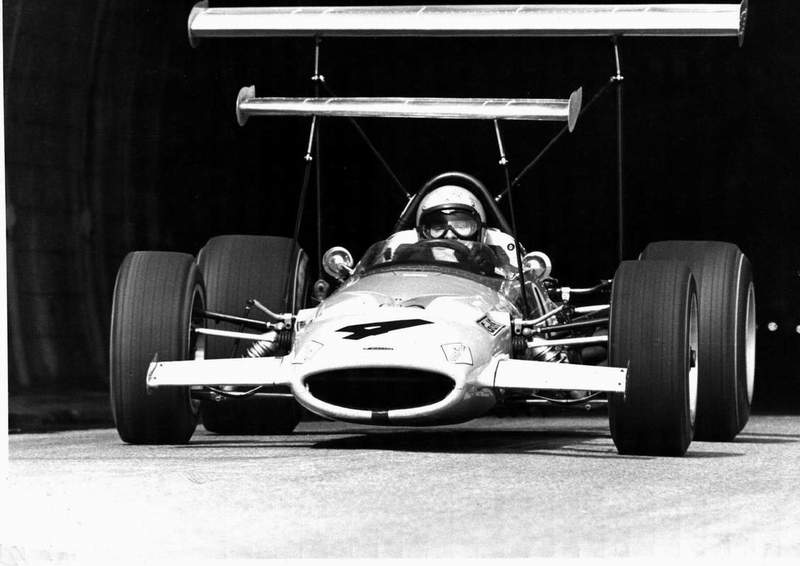 Photo by Michael Hewitt |
|
| M7B - 1969 The M7B started as a M7A-3 fitted with broad pannier style fuel tanks at the beginning of the 1969 season as a research vehicle to test weight distribution and give room for the adoption of a four wheel drive system. It was not very successful and was sold. Apart from the panniers, its specification was little different from the standard M7A's |
|
| M7C
- 1969 While the M7A type bathtub chassis were tough and accessible, they lacked some of the torsional rigidity achieved in the 1968 Formula A/5000 cars. Consequently one F1 car was built using a full "up and over" monocoque chassis identical to the M10A 5 litre cars and the machine, known as M7C-1, was Bruce's personal car in the 1969 F1 season. In general specification it was similar to the M7A cars. |
 |
| M7D - 1970 Team McLaren built this car in association with Autodelta early in 1970 to accept one of their Alfa Romeo T33 V-8 engines. The new chassis followed the two year old M7 series design but was two inches longer. |
|
| M8A
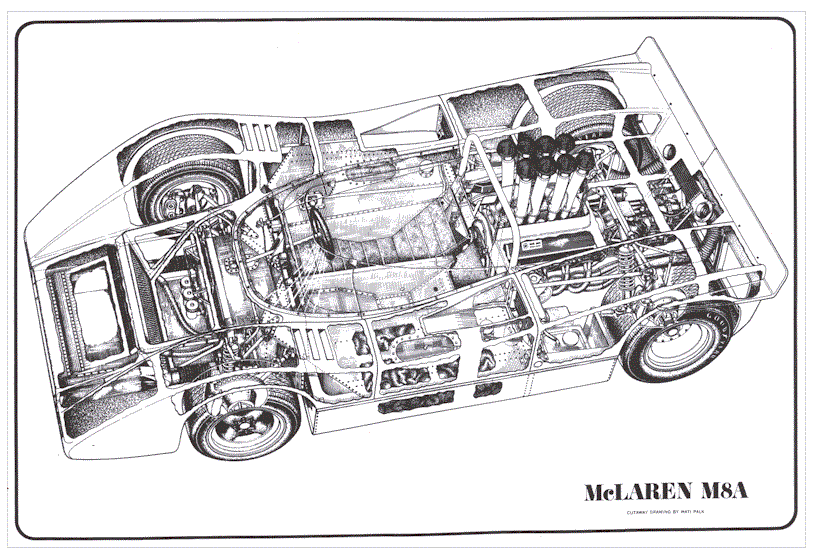
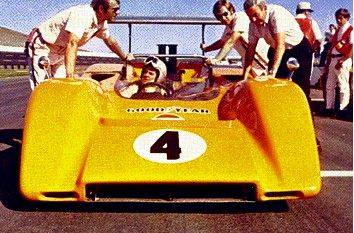
- 1968 The 1968 Can-Am works cars were further developments of the very successful M6A design and were again kept as simple as possible, employing single curvature panelling and square tube sections in the monocoque, which now used the engine as a partially stressed structural member. Three cars were built, dominating the series with Denny winning the championship. Chassis: Aluminium alloy and magnesium panelling monocoque based
on steel bulkheads and using the Chevrolet engine as a partially stressed structural
member stiffening the rear bay. |
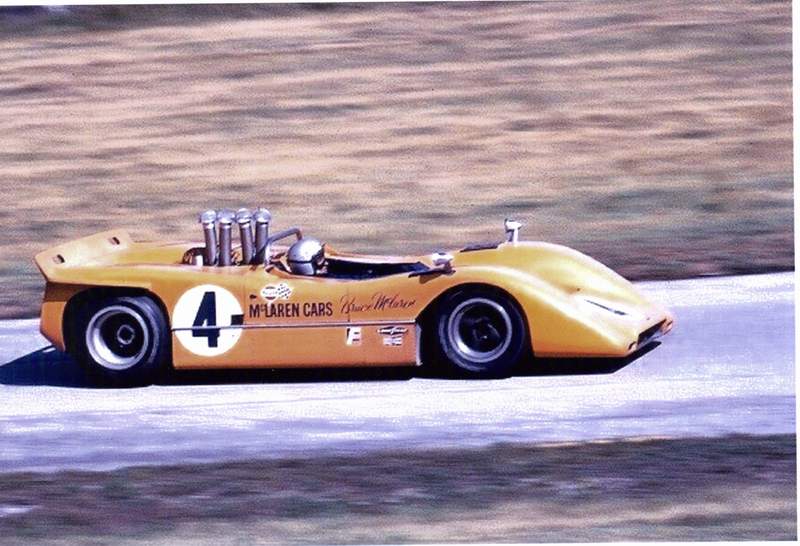 Photo by Don Markle |
 Photo by Don Markle |
|
| M8B
- 1969 Three new and further developed Group 7 works cars were built for the 1969 Can-Am series, using at least one of the original M8A monocoque. They differed form the earlier cars in body design, using wings that stood high above the the tail on suspension mounted struts and had new 7 litre engines built by George Bolthoff, an ex Traco engineer. There were minor detail differences between the M8B's and the M8A's. The 1969 cars used larger wheels 15 x 11 front and 15 x 16 rear. They were unbeaten in the 1969 season and took Bruce to his second championship. |
|
 Photo by Don Markle |
|
| M8C - 1970 Trojan produced this production version of the all conquering M-8 series. Modifications were made to accommodate engine choices as stipulated by the customer. Trojan manufactured 15 M8Cs'. Chassis:
|
|
| M8D - 1970 Three new cars were built for the 1970 Can-Am Championship and were improvements of the previous model. This model incorporated airfoils sections mounted on fins rising form the rear fenders. These cars earned the nick name of "Batmobile", The M8D ran engines built by Bolthoff and they again were successful in winning the championship. Hulme won the championship after Bruce was killed testing the original M8D at Goodwood. Chassis: |
 |
| M8E - 1971 Trojan produced this model as the 1971 production car based on the prototype tested by Hulme. It has the basic shape of the M8B with a lower wing rather than the fins of the M8D, the track is narrower and the bodyshell is smaller. Chassis: |
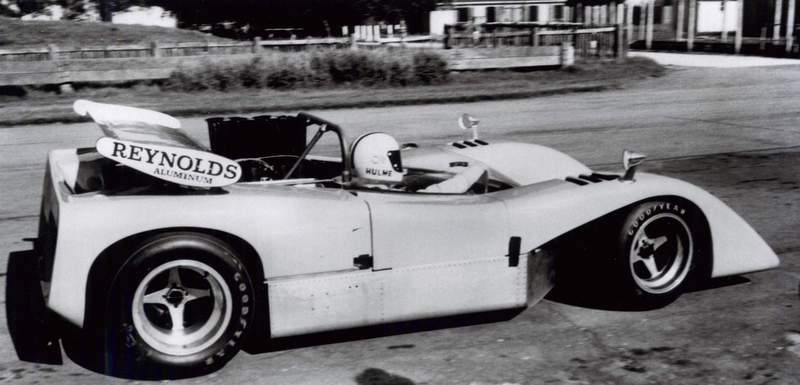 Photo from the family collection |
| M8F - 1971 The 1971 Can-Am M8F car was designed by G. Coppuck and included a number of innovations. It ran with an 8 litre Chevrolet built by McLaren Engines using the new Reynolds all alloy cylinder block. Horsepower was rated in excess of 740hp. Chassis: |
 |
| M8FP
- 1972 1972 Trojan production Can-Am cars Chassis:
|
|
| M9A -
1969 McLaren Racing developed the M9A as a four wheel drive during the 69 season. The cars used a Cosworth-Ford engine turned back to front driving through to a McLaren designed 4wd transmission. Despite exhaustive testing then car was raced only once and as with other manufacturers, 4wd projects were abandoned. Chassis:
|
 Photo by Michael Cooper |
| M10A
- 1969 McLaren were one of the few successful manufacturers to produce Formula A/5000 cars. This Formula was introduced in 1969. The M10A was extremely successful and dominated the first season of the European Formula 5000. Trojan built 17 cars that season. Chassis: |
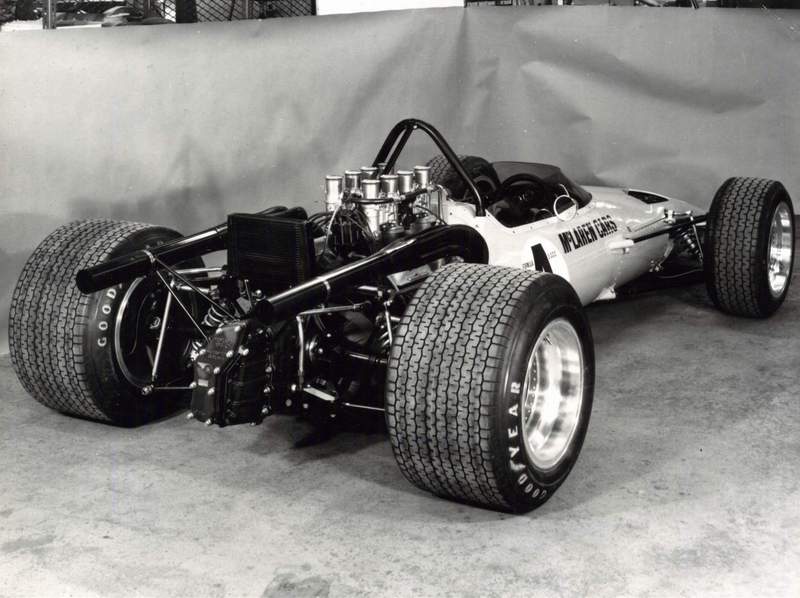 Photo from the Hunter family collection |
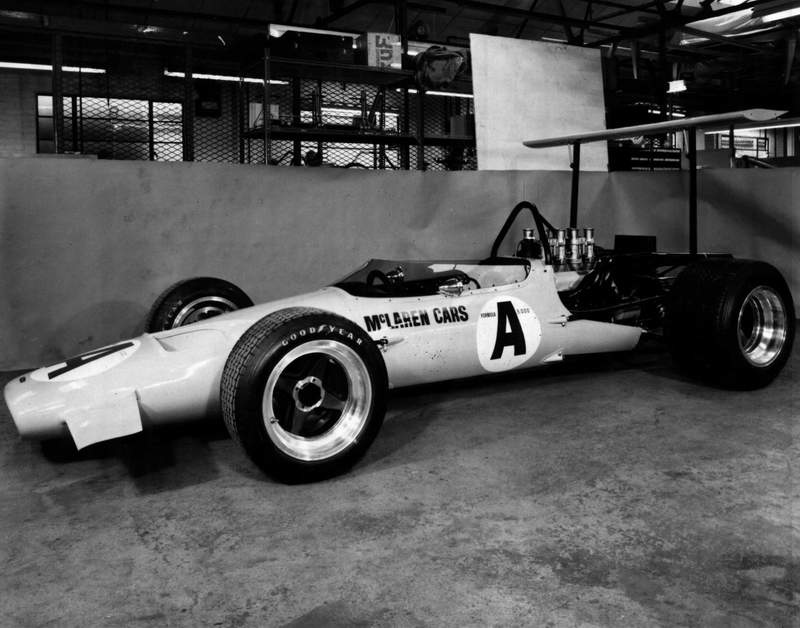 Photo from the Hunter family collection |
|
| M10B -
1970-71 The 1970 development of the M10A differed in several aspects derived around weight saving initiatives. Peter Gethin won his second consecutive Guards F5000 championship with one of the twenty-one cars built. Chassis: |
 |
| M11 The M11 designation was not used due to possible confusion with "Mark II". |
|
| M12
- 1969 This was an out of sequence designation applied to the 1969 production Group 7 sports/racer. It used an M8 type bodyshell on an M6 series monocoque tub. A total of 15 cars were produced. Chaparral campaigned one while its own 2G model was being developed. Several GT versions were built by Trojan. Chassis:
|
 |
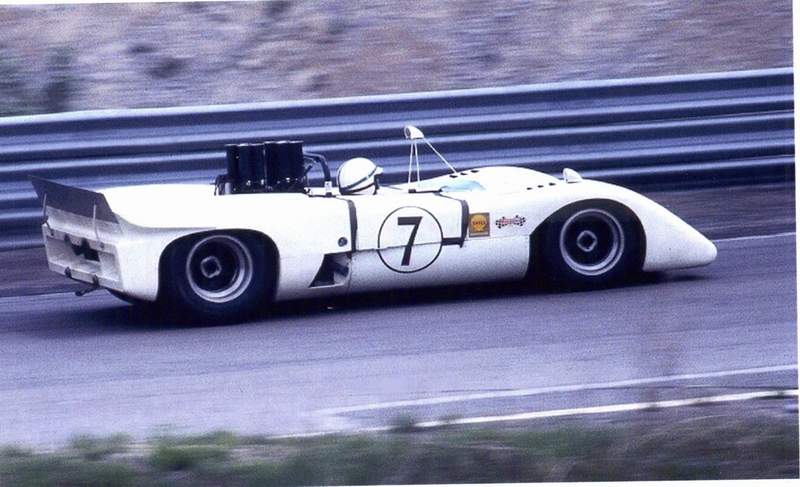 Photo by Don Markle |
|
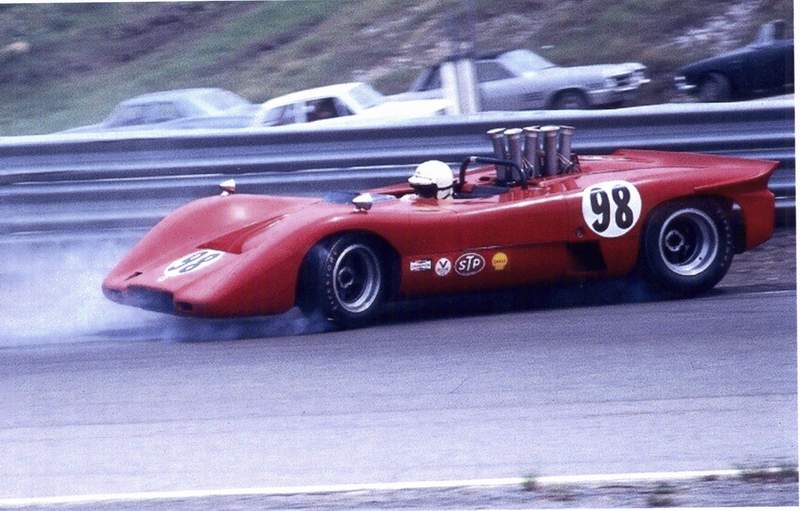 Photo by Don Markle |
|
| M12GT Specifications as for the M12, however it had a shortened M6GT coachwork fitted to it. See the story about this car |
 Photo from the Hunter family collection |
| M13 The M13 designation was not allocated. |
|
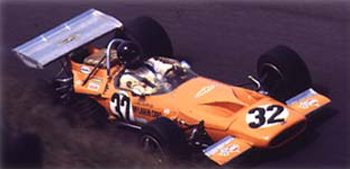
| M14A
- 1970 Three 1970 Formula 1 cars were built at the start of the season. The design team of Bruce, Gordon Coppuck and Jo Marquart had made several important innovations. The most notable was to mount the rear brakes inboard in an effort to save unsprung weight. Chassis: Full monocoque with aluminium and
magnesium panelling bonded to fabricated steel bulkheads, terminating behind the rear
cockpit bulkhead and using the engine as a fully-stressed chassis member. |
|
 |
|
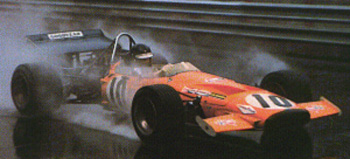
| M14D - 1970 This was a one off car built halfway through the 1970 season to accept an Alfa-Romeo T33 V-8 engine.as with the M7A. Chassis:
Full monocoque with aluminium and magnesium panelling bonded to fabricated steel
bulkheads, terminating behind the rear cockpit bulkhead and using the engine as a
fully-stressed chassis member. |
 |
| M15A
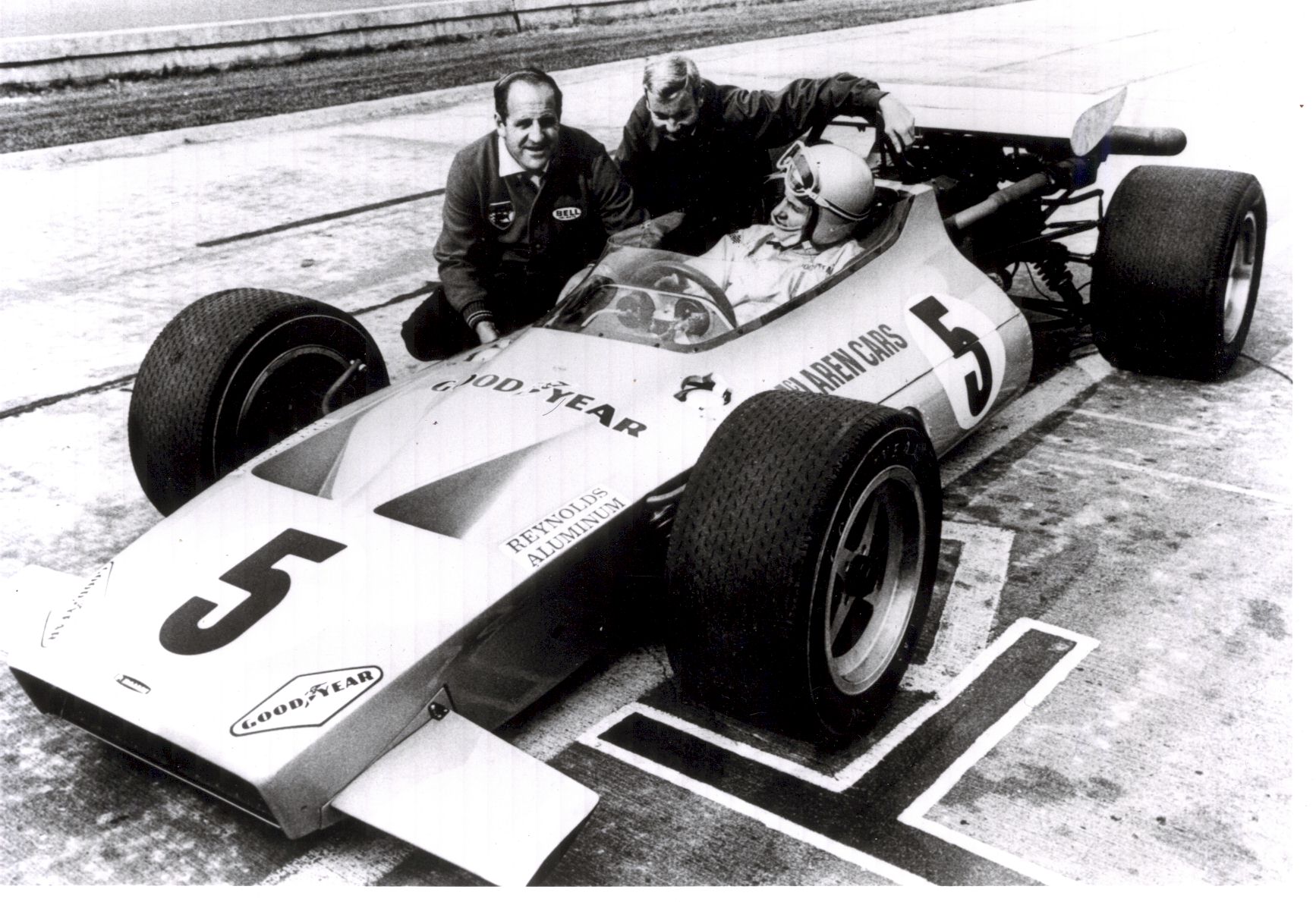
- 1970 1970 was a year that McLaren took Indianapolis by storm. Its first attempt at the Brickyard saw it take the prestigious designers award. The team built three cars based closely on the simple and yet effective Can-am designs. The car was powered by a turbo charged Offenhauser 4 cylinder. Sadly Denny was burnt and Amon found that he could not build up to the speeds demanded. Peter Revson and Carl Williams took over the remaining two cars. Chassis: Broad
aluminium-alloy panelled monocoque formed over steel and aluminium bulkheads, with the
engine acting as 2 semi-stressed member in the rear bay. |
Photo from the Hunter family collection |
Photo Indianapolis Motor Speedway Official Photos |
|
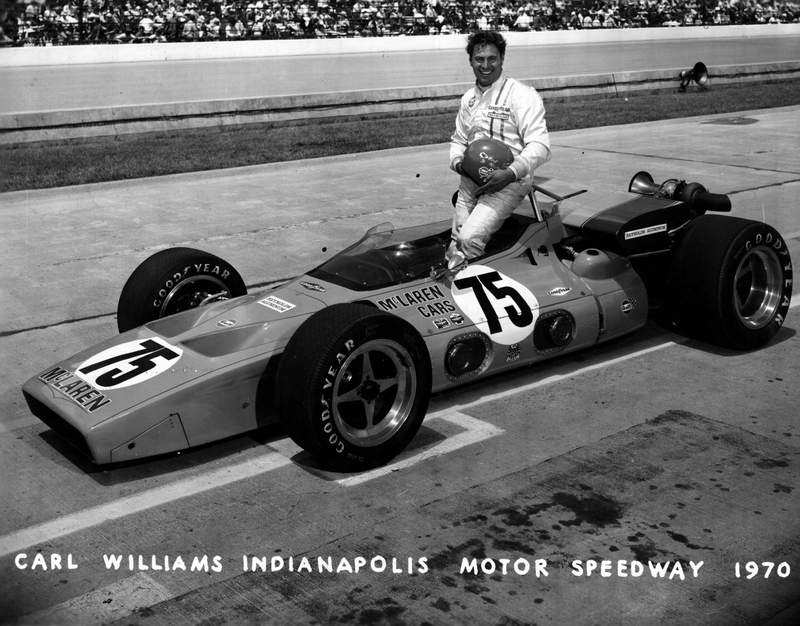 Photo Indianapolis Motor Speedway Official Photos |
|
| M16A
- 1971 1971 saw the first wedge shaped Indy 500 car, The M16 series won Indy at the hands of Johnny Rutherford. Chassis: |
|
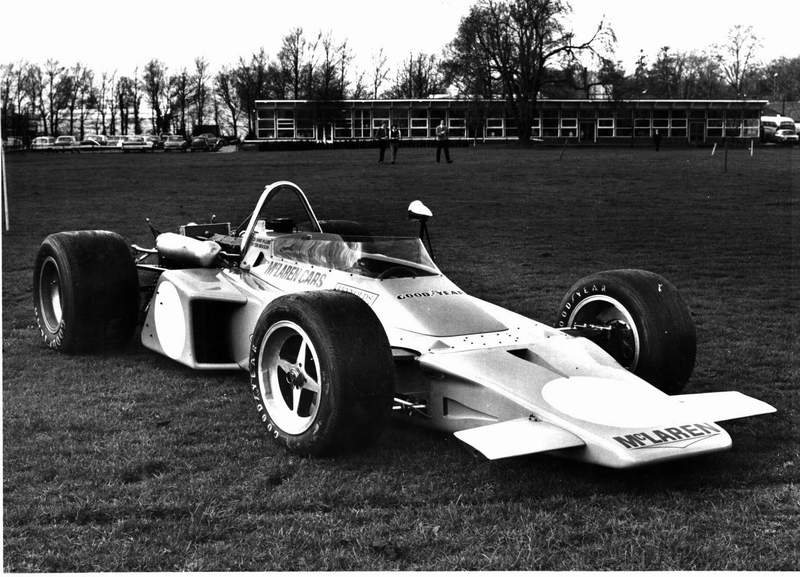 Photo Michael Cooper |
|
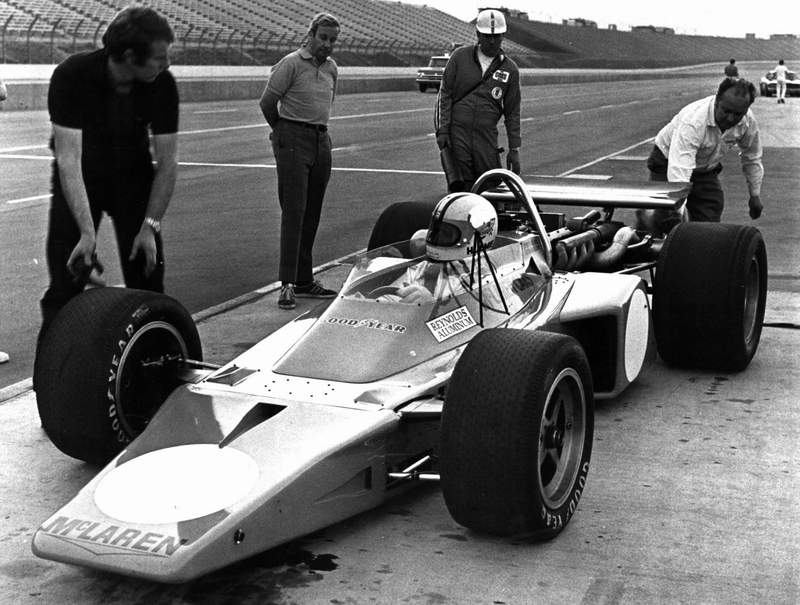 Photo from the Hunter family collection |
|
| M16B - 1972 1972 Indianapolis/USAC cars developed from the M16A. These cars were built at Colnbrook in the UK and campaigned by the McLaren team and the Penske team. Chassis: |
|
| M16C- 1973 !973 Indianapolis/USAC Chassis: |
|
| M16C/D - 1974 !974 Indianapolis/USAC Chassis: |
|
| M16E - 1975/6 !975/1976 John Barnard re-worked Indianapolis/USAC Chassis: |
|
| M17 The M17 designation was allocated to a 3-Litre prototype sports car but the project was abandoned. Chassis: |
|
| M18 - 1971 Trojan built this Formula A/5000 and this production model for 1971 used a 5 litre Chevrolet V-8 with a Hewland DG trans-axle. The M18 is a much revised Formula A/5000 car with a much lower flatter nose. Chassis:
It has a full aluminium monocoque chassis . |
Photo from the Hunter family collection |
| M19A
- 1971 The Formula 1 car for 1971 again was powered by a Cosworth-Ford DFV V-8 engine. The car is a "coke bottle" shape. The design team was headed by Ralph Bellamy. Chassis: . It has an aluminium monocoque |
Photo from the Hunter family collection |
Photo from Reynolds Aluminium |
|
| M20 - 1972 The M20 Can-Am car was was built around the "coke bottle" platform with a low polar movement chassis, but unfortunately was beaten by the Porsche works entry. Chassis: |
|
| M21 -
1972 Ralph Bellamy. designed works Formula 2 planned for production by Trojan. This car was formed on the 1973 Trojan - designed and built (non McLaren) F5000 customer car. |
|
| M22 - 1972 1972 Trojan production Formula 5000 car for customer sale. |
|
| M23 -
1973 The 1973 deformable structure works Formula 1 car won the 1974 and 1976 Worlds championships.. This is believed to be one of the classic Grand Prix cars of all time. |
|
| M24 - 1977 The 1977 Indianapolis/USAC track car using the Cosworth DFX turbocharged engine. |
|
| M25 - 1975 This was John Barnard's still born 1975 Formula 5000 car based on the successful M23 experience. |
|
| M26 - 1976-78 This works car was penned by Gordon Coppuck and campaigned during the 76 -78 Formula 1 series. |
|
| M27 - This car the replacement for the M26 was shelved, it was based on non ground effects. |
|
| M28 - 1979 1979 saw the year of ground effects in Formula 1, this car was not a success. |
|
| M29 - 1979 This works car was a hasty William's copy ground effect cars replacing the M28. |
|
| M30 - 1980 This year saw the Formula 1 works car with advanced ground effects, intended to revive McLarens competitiveness, it unfortunately failed and the lone M30 was written off in the US GP. |