|
Technical report: McLaren-Olds Series II If you want to buy the fastest sports / racing car being built today, you'd better see Bruce McLaren! Text & Photos: Pete Biro - Reprinted from the Sports Car Graphic Magazine January 1966 |
||||
|
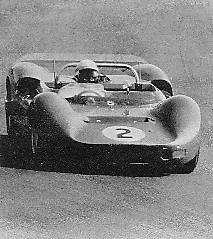
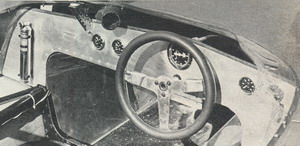
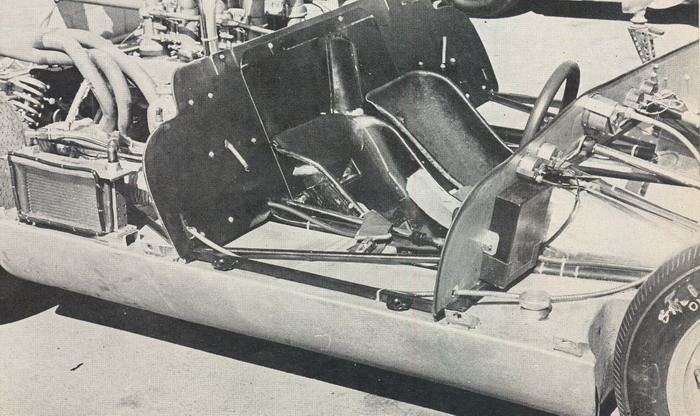
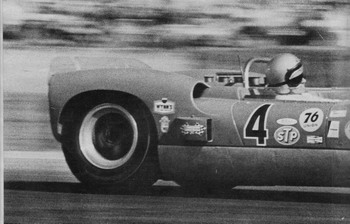
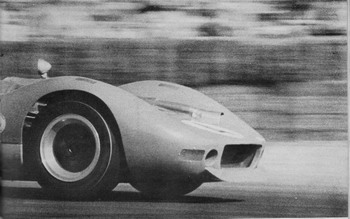
JUST ABOUT A YEAR AGO, BRUCE McLAREN ARRIVED to do battle on the North American Continent with a brand new sports/racer, designated the McLaren I. With it Bruce proceeded to take the circuit record at Mosport, just missing the record at Riverside, winning the qualification race and barely missed taking the whole show be�cause of a minor non-design-caused burst water hose. Following these very successful performances, Bruce contracted Elva Cars to produce his design in quantity, for sale to aspiring Chaparral hunters. In all there were eighteen Series McLaren I produced, with thirteen of them running in North America. Three chassis were built by McLaren's own crew; the one he raced last season (which is now used for tire testing), one car which he calls "half production" built for Dan Gurney, and now a new car for himself, the Series II, with evolutionary, rather than revolutionary changes. From all outward appearances the new Series-II McLaren looks like a completely new car. The original bodywork has been scrapped and a new body-designed by English artist Michael Turner has been fitted. Turner did not have a completely free hand to draw just what he wanted from a purely aesthetic view�point; Bruce set down a very rigid set of cross section and aerodynamic requirements, and after the final drawings were made, a model was built for wind tunnel testing. Much attention was paid to the drag and lift characteristics, with a net result of about 20-percent less drag than with the Series I. Radiator ducting studies were conducted to achieve the optimum flow characteristics. Following contemporary practices, a spoiler has been fitted to the tail of Bruce's car, but a very original bit of thinking went into its construction It is fabricated from craft quality Plexiglass, and is clear, enabling the driver to see behind him. Many spoilers hinder rearward vision. After a couple of appearances it was noted that three or four other cars switched to clear Plexiglass spoilers. At Mosport this year in the new car, McLaren led 96 of 100 laps, only be overtaken by Jim Hall's Chapparal in the closing moments. At Kent Phil Hill took over the controls, putting up the only threat to the Chapparals, finally taking the lap record at 1:20 flat, Phil led until he was forced into the pits to repair a sticking throttle. Bruce skipped Laguna Seca and made his next appearance at Riverside, where he smashed the lap record with a 1 :26,6, 1d easily won the qualifying race. In the main event, Bruce found himself in the wrong gear at the start, then in the pits to replace a flat tire, finishing a strong third, much closer, to the winner than the time consumed in his pit stop. Like the Series I, Bruce's Series II is constructed of round and square tubing with only subtle changes made for strengthening. Four main rails are used, with truss-type out�riggers above the side mounted, pontoon-like fuel tanks, adding to the rigidity. The floor pan, as well as the wheel-well sheet metal, is stressed. The firewall behind the driver is aluminum-alloy sandwiching a wood core, with a removable center door in the firewall to get at the front accessory drive units on the engine. A pair of semi-reclining alloy bucket seats are fitted. |
||||
|
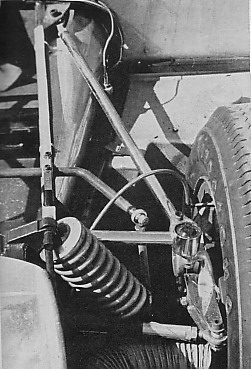
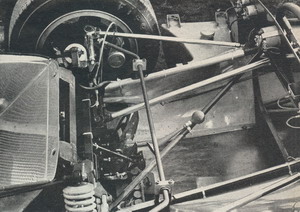
Anti-dive front suspension layouts are used with very-wide-based pickup points. The upper A-arm has a side link, with a leading arm attached to the cockpit scuttle-hoop. The lower A-arm is comprised of a side link with a trailing arm attaching to a forward frame member, placing the fore and aft suspension arms in tension instead of compression. Inclination of the upper arm reduces the tendency to nosedive under braking loads. An anti-sway bar crosses the frame above the driver's feet, angling forward to join the lower A-arm via a ball-jointed vertical link. The bar is carried in a Teflon bearing surface, is removable and is attached with screws. Telescopic shocks, wrapped with adjustable-tension coil springs are fitted front and rear. Girling BR calipers squeeze 12-inch meehanite discs. Steel braided, Teflon, Aeroquip brake lines are fitted. which eliminate any spongy feel in the pedal. Cool air is fed to the discs via flexible hose, with the air inlets in the nose. |
|
|
||
|
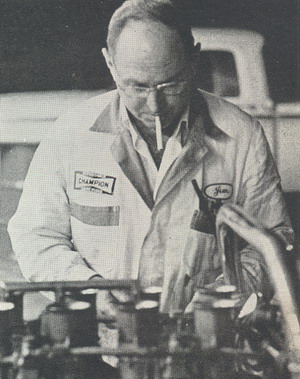
Above, -Jim -Travers of TRACO looks on Bruce's 5 Litre Olds with tender, loving care as McLaren's use of their engines opened the European market for them. Below, the revamped Series II car has a stubby body that makes it appear smaller, even though wheelbase and track dimensions are the same. Its chassis and suspension have been strengthened and redesigned. |
||||
  |
||||
|
|
|
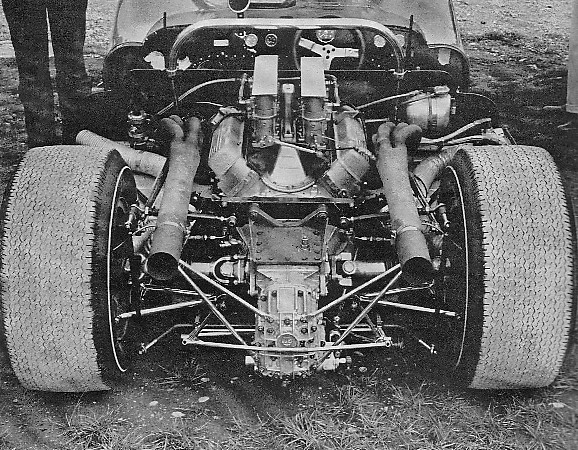
The rear suspension follows con�ventional practice, with a single Upper sidelink, a reversed lower wish�bone and trailing links for fore and aft location. Bruce is still experimenting with the upper-link length and pick-up point, trying to get the least camber change with a link about two inches longer at Kent than on the production versions, but at Riverside the car was fitted with the shorter link. The same size Girling calipers are fitted at the rear, as are fitted up front. The rear anti-sway bar runs across the chassis below the trans-axle, along the rear frame bulkhead, mounted in Teflon, attaching to the upper end of the hub carrier via vertical ball jointed links. A choice of gearboxes is offered with the five-speed ZF being fitted to Bruce's, Oldsmobiled version. Weighing but 127 pounds, the ZF is not considered heavy enough for use with bigger torquers, like Fords or Chevies, and for these applications Bruce recommends the 135�pound Hewland LG-4. The wheels are driven through Mercedes Benz internally splined drive shafts. |
||
|
|
||||
|
Steering arms are sheet steel, doubled and boxed to support spherical joint top and bottom |
|
|
||
|
|
||||
|
|
||||
|
McLaren cast magnesium wheels are fitted, carrying Firestone "Indy" tires, with two-inches wider track than before. His wheel design appears to provide very good ventilation for the brakes, without sacrificing strength. The bodywork fitted to this car is aluminum, and future copies, once finalized, will be made from fiberglass. One thing that has allowed Bruce to build a much slimmer, slipperier car is the revised FIA rules, particularly in the case of not having to carry a spare tire. Looking at the Series I, it appeared that the biggest design limitation was having to carry the spare above the driver's legs. Quite stubby looking, the new car is 14-inches shorter than the Series I. The handling of the new car appears to be equal to anything going, Phil Hill stating: "It's the most honest car, with the best manners, I've ever driven." Phil liked the engineering, adding: "The controls are very consistent, and the brake equalizer really works." Through the very difficult Turn Six at Riverside, we were able to get corner times from Shelby driving instructor John Timanus, who has special points of reference he uses in his classes. Timanus said: "The fastest cars through six were McLarens, with Graham Hill at 10 seconds flat in the Series I, while Bruce went through at 10.3-seconds. Graham's car had a bit more oversteer allowing him a slightly quicker exit." The oversteer probably hurt Hill in the quicker turns, Bruce having the faster lap times. Part of the reason for Bruce's fast times can be attributed to what's under the rear hood. For some time now Bruce has been working very closely with Jim Travers and Frank Coons, the Whiz Kids from Venice, California known as TRACO. Their emblem shows a big arm with a dumbbell bending to its grip, bearing a tattoo with the words "STRONG MOTHER" in the appropriate spot. They aren't kidding. Taking a little aluminum Olds block, TRACOizing includes an increase of displacement to 300 inches (five liters), adding an Engle roller-camshaft, with stock rocker arms, but a specially fabricated steel rocker stand. JE pistons are running' Warren-machine 'H-beam' rods that just don't give up, which in turn are motivated by a Moldex 3.400 crank. Pins are special, as are oversized valves, with rings by Perfect Circle. Four two-throat 45mm Weber carburetors ride on a special TRACO manifold. Horsepower has been increased over last year's 350 to a very healthy, long'-living', 392. Bruce chose the Olds over the bigger, more powerful Chevy because it is 200 pounds lighter than the Chevy, and with the Olds, lighter running gear can be used. There is less of a problem with weight transfer too. Dry weight estimates run right around 1285 pounds, with a ready-to-charge weight, including driver and fuel, right near 1550. One of the key men in the McLaren operation is Tyler Alexander, who does much of the car building, and of course team manager, Teddy Mayer, who handles the business end, as well as the strategy_ Assisting with preparation (you'll have to go a long way to find a better prepared car) is Bruce's brother, "Little Bruce" and "Beany". Tyler says: "The only thing you can get, right now in racing, that you can just .turn on' and have it absolutely right . . . ready to go . . . is a TRACO engine." It looks like the new McLaren,an he added to that list. Carl Haas, the U. S. importer, told us he plans to be able to start delivering copies in January, at about eleven�thou, less engine, but with gearbox and tires. Oh yes . . . Bruce is testing a new three-liter Formula One car with his name on it. If it goes like his Sports/racing car...look out Wee Jimmie! |
||||
|
Reprinted from the Sports Car Graphic Magazine January 1966 |
||||