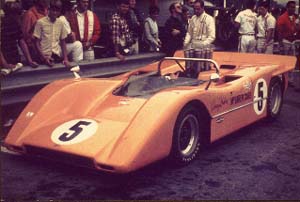
McLaren M8A |
||
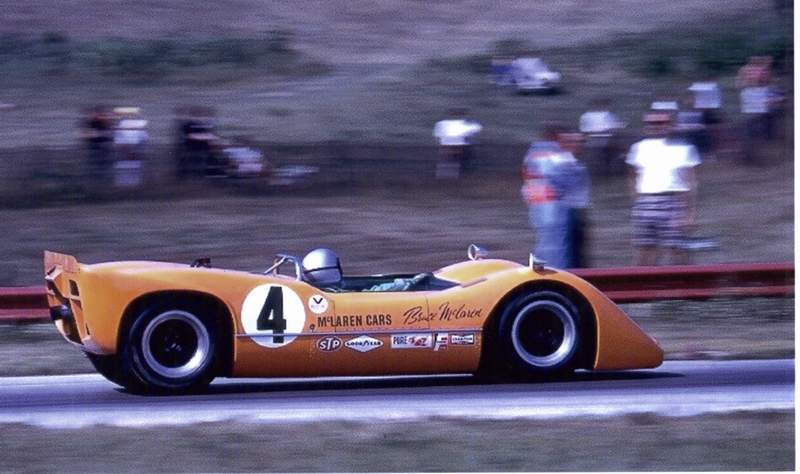
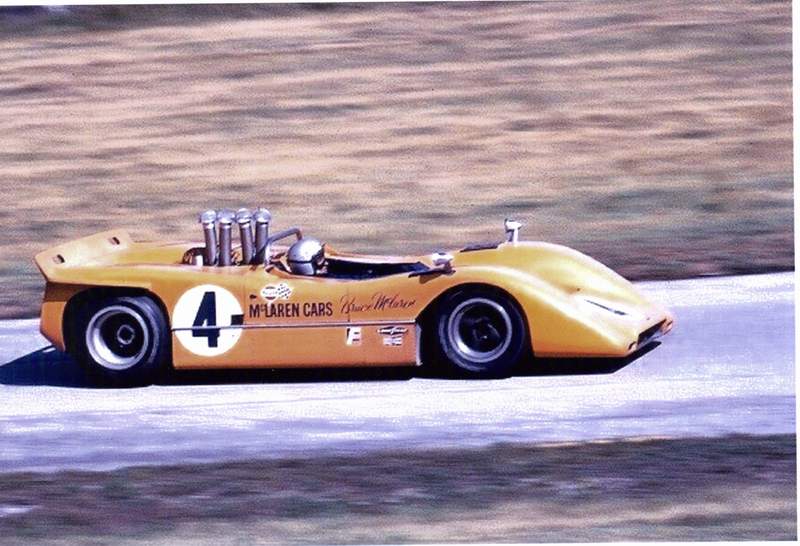
The formula for this Can Am series is pretty simple; virtually any size of engine is allowed and you can fit it to any two-seater racing car. Since very powerful pushrod ohv engines are available in America most teams used these, although Ferrari belatedly entered a 6.2 litre four overhead camshaft V12 which showed promise. In 1968 General Motors, who are allegedly against racing, produced a special batch of all aluminium 7-litre pushrod Chevrolet engines which were sold to Can Am contestants at a fairly low price. The leading teams all used these and the rival Ford engine hardly got a look-in. The McLaren engine men went over the engines with a fine tooth comb and found a few more horsepower as well as converting them to fuel injection and they ended up with something like 620bhp which gave these exciting sports cars a top speed of over 200mph on the fastest circuits.
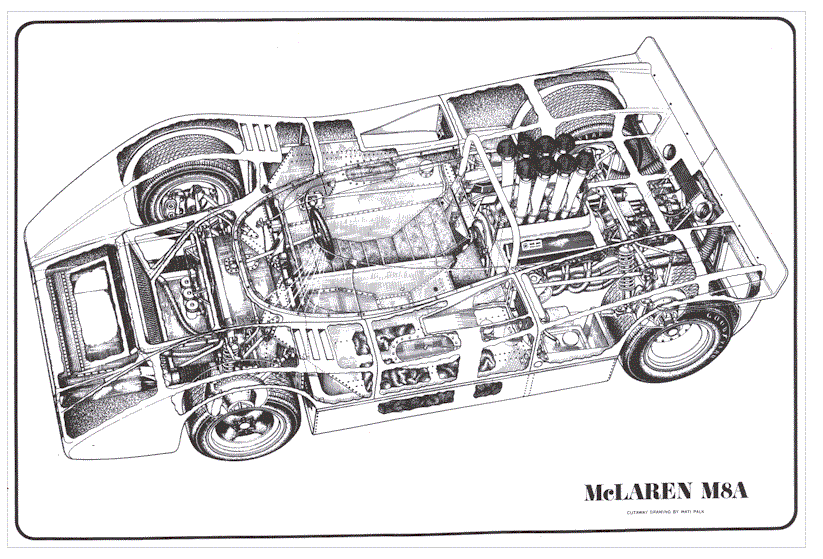
The front suspension is by double wishbones with outboard mounted coil spring/damper units while at the rear the usual single transverse top links, lower reversed wishbones, and radius arms are fitted, the radius arms being the only connection the rear suspension has with the chassis as these are mounted at the forward end of the rear of the monocoque. The brakes are Lockheed 12in ventilated discs outboard mounted all round with plenty of cool air ducting. Steering is by rack and pinion, and wheels are McLaren castings of 15in diameter with 10in rims at the front and 15in at the rear. The 7 litre aluminium engine supplied by Chevrolet is among the most powerful racing anywhere today even though it uses ordinary pushrod overhead valves. Converted by McLaren to use Lucas petrol injection the engine gives no less than 620bhp at 7,000rpm from its 7 litres (427 cu.in.) and is very light as well. It transmits its power through a Borg and Beck tripe plate clutch to a very strong Hewland LG 50- 4-speed gearbox. Article first published 1968-70 Prototype |
||
 Bruce McLaren
and his team mate Denny Hulme set a unique pattern in 1967 when they finished first and
second in the dollar rich Canadian-American series for Group 7 sports cars. They alone of
the European constructors realised the prestige to be gained from winning the series as
well as the not inconsiderable prize money and the orders for replica cars for the next
year’s series. In fact so large was the order book at the end of the 1967 series that
the small Bruce McLaren Motor Racing factory near Slough could not cope and they were glad
of their tie-up with the Lambretta Trojan people who had previously built Elva
sports/racing car under licence. Under the licensing agreement Trojan were to build the
production versions of the McLaren, leaving the McLaren factory free to build the works
cars and prototypes. Thus the 1967 factory car the
Bruce McLaren
and his team mate Denny Hulme set a unique pattern in 1967 when they finished first and
second in the dollar rich Canadian-American series for Group 7 sports cars. They alone of
the European constructors realised the prestige to be gained from winning the series as
well as the not inconsiderable prize money and the orders for replica cars for the next
year’s series. In fact so large was the order book at the end of the 1967 series that
the small Bruce McLaren Motor Racing factory near Slough could not cope and they were glad
of their tie-up with the Lambretta Trojan people who had previously built Elva
sports/racing car under licence. Under the licensing agreement Trojan were to build the
production versions of the McLaren, leaving the McLaren factory free to build the works
cars and prototypes. Thus the 1967 factory car the