Victory to Hulme Las Vegas Stardust Circuit |
||
| An easy victory at Las Vegas’ Stardust circuit gives Denis
Hulme the 1968 Can-Am Championship
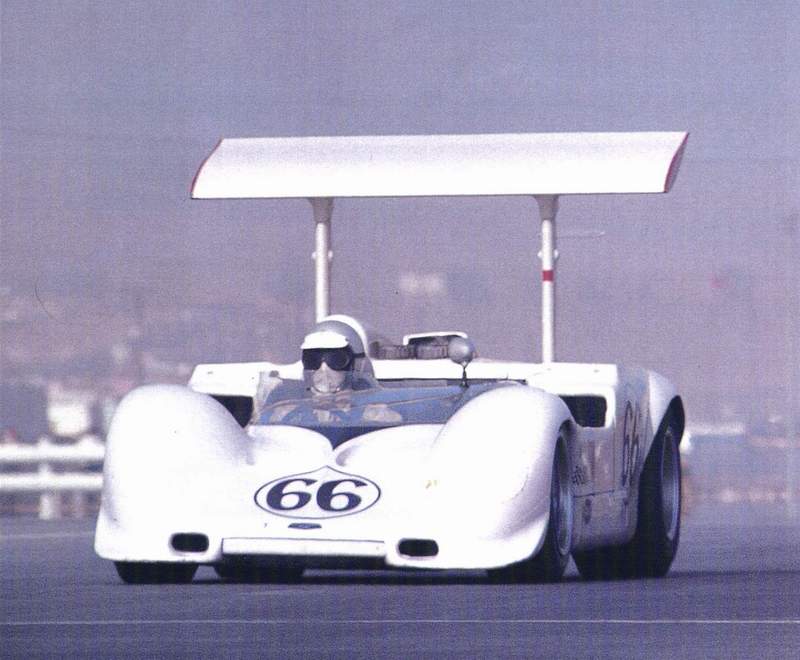
Denis Hulme won without being challenged and thereby became the 1968 Canadian-American Challenge Cup winner, that’s the story of the Can-Am finale at Las Vegas’ Stardust International Raceway. Hulme qualified his McLaren M8A-427 Chev in 1 min 29.98 sec. which was next-fastest behind team mate Bruce McLaren’s 1min 29.60. He nosed out ahead after the rolling start, got into turn 1 first, stayed out of trouble and was able to cruise to victory turning average laps of about 1.36. He got about $12,000 for his Stardust victory and collected the biggest share, $40,000, of the championship points fund. After the race he announced he would again be driving for McLaren during 1969 and that the team would be back for the expanded Can-Am series. Bruce McLaren squeaked through to a 6th place finish at Las Vegas and thereby beat out Mark Donohue for the $26,450 2nd place slice of points money. McLaren was involved in a first-lap melee that is becoming traditional at Las Vegas as almost exactly the same thing happened last year – except that it involved the back of the pack rather than the whole pack. As a result, McLaren had to make three pit stops – one of which was to replace the entire nose section of the car – but after that was able to scurry up the standings, post the race’s fastest lap and take over 6th place a dozen laps from the end. The first-lap dust-raiser occurred when McLaren and Mario Andretti came together trying to fit in behind Hulme as the pack swarmed through the first turn. Mario got most of the credit for the excitement (though his adherents claimed that McLaren moved over on him) and when McLaren was bumped and spun, there were cars going off the road on both sides trying to avoid each other. When the dust settled, Andretti was in 2nd behind Hulme and there were two cars parked off the road. One of these was Chris Amon’s 6.3 litre Ferrari 612, which had its throttle slides jammed with sand. The other was Charlie Hayes’ McKee-0lds, which refused to start again after the trip into the dirt. Andretti, his George Bignotti Lola T160-427 Ford running properly for the first time in the series, followed Hulme for one lap then pitted to replace a tire and fix a fuel line. He got back into the race four laps later and finally finished 12th, seven laps behind. Dan Gurney took over 2nd place when Andretti pitted but dropped out after 15 laps with a broken half shaft on his Lola T160-427 Ford. This moved Lothar Motschenbacher’s McLaren M6B-427 Chev up to 2nd place and he kept it there until lap 59 when he and Jim Hall crashed. George Follmer inherited 2nd in the Agapiou Lola T70-427 (iron) Ford at that point and held it to the end. Jerry Titus was 3rd in his McLaren M6B-365 Chev, then came Chuck Parsons in Carl Haas’ Lola T160-427 Chev, Sam Posey in the Autodynamics Lola T160-427 (which could have been 2nd but for the thirst of his 427 engine) and McLaren in 6th. The Motschenbacher-Hall crash was spectacular. Hall’s Chaparral 2G-427 Chev had suffered body damage in the first lap contretemps and after pitting to have it neatened up, he dropped to 22nd place. Moving very well, he got all the way up to 4th place but then had to pit again for more body-work to be trimmed and replace a tire in lap 43. This put him back to 9th and he’d moved up to 8th, one lap behind, when the accident took place. Hall was overtaking Motschenbacher, preparing to unlap himself, when Motschenbacher’s McLaren broke a suspension upright and all but stopped in front of Hall. The Chaparral rode up over the left rear of the McLaren, flew high into the air, then rolled and tumbled to the outside of the turn and came to rest upside down. Corner workers hurried to Motschenbacher’s car, apparently not realising that the pile of debris down the road was another car and it remained for Car and Driver associate editor Charlie Fox and two others to rush to the overturned Chaparral, lift it up and drag the injured driver free. Hall was taken to the hospital with both legs broken, a broken jaw and minor burns suffered when the car lit up and the trail of gasoline over the to inert Hall was ignited. Motschenbacher escaped with bruises and minor burns from a fire that sprung up in the cockpit of his McLaren. So far as outstanding driving facts in the Stardust GP, perhaps Sam Posey was the best candidate for that prize. Sam had a good race, obviously, and turned the race’s 2nd fastest lap with a 1;31.49 (compared to McLaren’s fast lap of 1;30.59 and a full half-second quicker than Hulme’s best race lap) and would have been a cinch for 2nd if he hadn’t had to stop for fuel. There were several bad performances, unfortunately, and that prize should be shared equally between the several non-competitive, way-out-of-their-class drivers, who, as one front-runner said, made it necessary to "take your life in your hands to get around them." There were six drivers that didn’t get under 1:42 on their fastest lap of the race (and several that were cruising at 1:50 and worse) which meant that had to be lapped every 10 or 12 times around by the leaders, which was certainly no fun. Deserving a good mark for the job they did was the Long Beach MG Club scoring team who kept everything straight throughout the several messes, pit stops, shufflings and re-shufflings. Until I saw their charts after the race I had no idea how far off my own lap chart had been. For pure frustration, the worst luck of the weekend had to be that of Mark Donohue whose Penske-owned. Sunoco-sponsored McLaren M6B-427 Chev would not start on the grid due to a faulty coil. Donohue and McLaren were tied for 2nd in the standings going into the Stardust race and Bruce’s one big point for 6th place was worth almost $10,000 to him as he got $26,450 and Mark had to settle for $16,700. Missing altogether from the Las Vegas field was John Surtees who simply came as a spectator rather than fight his Weslake-headed Chev engine through another weekend. He says now that he knows what the problems are and will be ready to go next year. Ferrari’s luck was uncommonly poor. Finally arriving in this country in time for the last race, the basso-profundo V-12 worked up to qualify 9th-fastest at 1:32.20 (compared to McLaren’s 1:29.63). The car had suspension and braking troubles even in its brief practice periods and though it seems unlikely that it would have gone the distance, to have been eliminated in the first very turn was heartbreaking. At the cocktail party in the Stardust Hotel on Sunday evening after the race, the $126,000 championship points fund ($90,000 from the six organisers plus $36,000 from Johnson Wax Co.) was divided up. In addition to several brief speeches, at $1,000 Sportsmanship Award from Triangle Publications was made to John Cannon. This selection, for "the driver who epitomises the highest ideals of a professional driver in skill, attitude and courtesy" was made by the drivers themselves and their choice was enthusiastically seconded by the crowd at the party. So the 1968 Can-Am season was over. Six races in ten weeks playing to bigger audiences and for larger amounts of money than ever before. The McLaren team was again outstanding, the only one that was ready to go out and win at every event. And, like last year, they made it look absurdly easy. Roger Penske’s Sunoco Special made the best showing for an American team but their combination of vehicle and operator was simply not quick enough to carry off first prize. Jim Hall’s season began badly when his new Chaparral wasn’t ready and ended with the unhappy crash at Las Vegas. Nobody else was ever in the chase. So far as equipment goes, it was another great year for McLaren cars, Chevrolet engines and Goodyear tires. As last year, Ford did it all wrong and makes you wonder what Ford management can be thinking of to allow themselves to be committed piecemeal with far too little and much too late. Lola-chassised cars were in the same nowhere as Ford engines, unfortunately, their best showing being George Follmer’s excellent 2nd place finish at Las Vegas. For next year the series will be expanded to 10 events with races at (probably) St. Jovite, Watkins Glen, Mid-Ohio and Mosport in addition to the six held this year. The McLaren team will start next season with the M8As which were sufficient unto the job this year. Penske has announced that he’s switching to Lolas next year and there’s a hint about for wheel drive as well as that there may be more than one car on the team. With Jim Halls injuries still unhealed, it’s no time to speculate about his plans for 1969. Dan Gurney, having announced that the Formula 1 Eagle project will be set aside in favour of racing in the U.S. next year, has promised a 2-car entry for himself and Swede Savage. John Cannon has demonstrated he’s capable of better things that the Mark 2 McLaren he had this year. Surtees says he’ll be back. We await the 1969 Can-Am with interest. Article by James T. Crow Road & Track |
||