|
IN
1966, the debut year of the Canadian American
Challenge Cup series - the Can Am for short -
Bruce McLaren's MIB sports cars were outclassed by their more powerful
Lola and Chaparral opposition. In 1972 the M20s lost out in the power
stakes to Roger Penske's brutally fast turbocharged Porsches. In the
intervening years, however, the Can Am was McLaren. The orange
cars from Colnbrook notched up 38 victories, while privateer cars
accounted for two more. Even in that final year of eclipse the works
cars won twice and a private example once, bringing the final marque
tally to an incredible 43.
McLaren himself won the Can Am title in 1967
and 1969, while team-mate Denny Hulme won it in 1968 and salvaged
something from the team's distress by taking his second title in 1970,
the year in which Bruce was killed testing an M8D. Hulme's 1971
team-mate was colorful American Peter Revson, who took the title in the
M8F.
When McLaren began
planning a replacement for the amazingly successful M6A at the end of
1967, the Can Am had already been
dubbed
'The Bruce and Denny Show'. In that year's six-race series Hulme
had achieved a hat-trick and Bruce a brace of wins, only 1966 Champion
John Surtees in a Lola getting a look in at the Las Vegas finale
when the McLaren steamroller ran into trouble.
If the opposition had been trampled into the dust in 1967, it was a
case, in American parlance, of 'you ain't seen nothin' yet' for 1968.
Delays with delivery of the BRM V12 engine
for Mdaren's 1967 M5A GP car had allowed the team to concentrate almost
exclusively on the M6A,which were
consequently tested
exhaustively.
McLaren
had grown eminent in GP racing in 1968 . with the Cosworth-powered M7
A', but the M8As weren't quite so race worthy although they had still
done 500 miles (805 km) running. Similar in concept to the M6A with
bathtub monocoque chassis, the M8A was four inches (10 cm) wider and
comprised a full monocoque using aluminum and magnesium panels bonded and riveted to steel
bulkheads. Its engine was now a stressed member supported by tubular
framework and where the M6A had used 5.8�litre Chevrolet V8s with S20
bhp, the M8A went the whole way with 7-litre unit, developed by Gary
Knutson. These gave 620 bhp, transmitted to the road via a Hewland LG600
gearbox to IS-inch (38 cm) wide Goodyear shod rear wheels. The
suspension followed M6A practice with upper and lower lateral links and
trailing radius arms at the front and a lateral top link, lower wishbone
and twin radius arms at the rear, all allied to outboard coil spring!
damper unite;. Solid disc brakes were replaced
by ventilated units all round.
|
|
In its first race - Elkhart Lake, Wisconsin on 1
September the M8A romped away, Hulme
leading McLaren home in a convincing display that
set the opposition quaking, especially as Hulme broke a rocker arm
part way through and finished on seven
cylinders . .
.
At Bridgehampton they led again, and although they
were sidelined by engine problems, American Mark Donohue (later to
play such a significant role in McLaren's eventual Ca eclipse) won for Roger
Penske in an M6B. At Edmonton he had to be satisfied with third to the M8 ,
Hulme again leading McLaren home, while a torrential rainstorm at Laguna
Seca, and a good wet tyre choice, saw John Cannon win in his aged
Oldsmobile-powered MIB with Hulme second and McLaren fifth.
Victories for
the M8A
Bruce's turn for glory came
at Riverside, where he won the Los Angeles Times
GP from Donohue, with a bodywork damaged Hulme
fifth. Donohue clinched his title at the Stardust GP finale at Vegas, with
Bruce nursing his ravaged car home sixth.
Throughout the series, only Donohue had posed a consistent
challenge through reliability. Both Peter Revson in a Ford powered M6B and
Texan Jim Hall in his Chevrolet-engined Chaparral 2G had been able to match
the M8A for speed on occasion, albeit without reliability.
For 1969 the M8 design was developed to
B specification into what McLaren's Teddy Mayer would later describe
as the team's most successful car.
The spoiler on the
rear bodywork was deleted and replaced by a
strut-mounted overhead aerofoil, the front wheel arches were cut back to
help exhaust air from beneath the nose, and a short stroke, big bore version
of the 1968 engine, now 7046 cc and 630 bhp, was
prepared by George Bolthoff. Testing again began early with a modified M8A
which was converted to full B specification once that had been settled.
In an ill-disguised attempt
to give rivals a better chance of getting on terms with McLaren, the Can
Am organisers had stretched the series from six to 11 rounds, but as
it was to transpire, the Bruce and Denny Show had only been playing in the
provinces in 1967 and '68. For 1969 it made it right to Broadway. In an
unmatched achievement, McLaren won every one of those 11 rounds. Bruce
triumphed in six, Denny five. In eight the 'orange elephants',
as the M8Bs became known were
first and second. At Michigan
Raceway in the eighth race they were first, second and third,
Dan Gurney handling the spare car after Jack Brabham had qualified it. A
year later in less happy circumstances he would again play
a significant role
for the team. . . .
|
|
 LEFT
Hulme in his McLaren M8D, 1970 LEFT
Hulme in his McLaren M8D, 1970
|
|
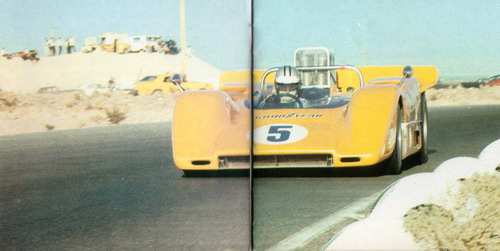 RIGHT
Hulme won this race at
Las Vegas in November
1968, driving the M8A RIGHT
Hulme won this race at
Las Vegas in November
1968, driving the M8A
|
|
While the M8C production version built and
marketed by Trojan in Britain was still a season away in 1969, there were
various customer M6s and M12s, and Gurney tried unsuccessfully to match his
M6B 'McLeagle' on 5.6-litre Ford power against the M8Bs when he wasn't
guesting for Colnbrook. Lola, whose T70 had won
Surtees the first
Can Am
title in 1966, had had a poor 1968 with the T160 and didn't fare much
better with its development T162/163 models, while Ferrari, having raced
sporadically in 1968, ran Chris on in a
developed version of the 612 six-litre V12 car
at he had driven in the last round the previous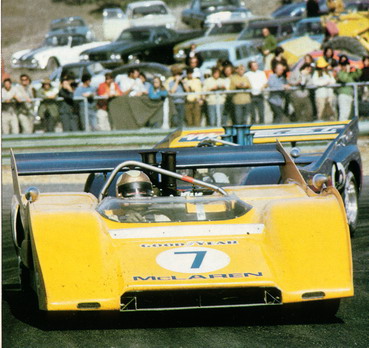 year The former McLaren driver finished third on his debut at a 'ns Glen
and created a sensation by leading Hulme at the next race at
Edmonton before finishing only
five seconds
in arrears. Thereafter, though,
the Italian thoroughbred proved breathless
with its litre
disadvantage and never again posed a real threat.
After it broke its engine at Laguna
Seca practice McLaren offered his old employee a ride in the spare M8B
but with typical Amon luck
its differential broke. The
narrow-track Chaparral 2H for Surtees was a total disaster,
proving that even Jim Hall could
make mistakes, while
Jack Oliver's Peter Bryant-designed Autocoast
Ti22 ( type numbered after the chemical
symbol and
valency of the titanium from which it was
made) showed late series promise. The car that caused the greatest
interest, however, and which would
ultimately prove the most significant newcomer from McLaren's point of
view, was the 4.5- then 5-litre Porsche 917 Spyder
driven by Jo Siffert. He had a few
reasonable placings but, like on, suffered from a capacity deficit,
proving the American adage that there
Revson's 8F, at Laguna Seca in 71
year The former McLaren driver finished third on his debut at a 'ns Glen
and created a sensation by leading Hulme at the next race at
Edmonton before finishing only
five seconds
in arrears. Thereafter, though,
the Italian thoroughbred proved breathless
with its litre
disadvantage and never again posed a real threat.
After it broke its engine at Laguna
Seca practice McLaren offered his old employee a ride in the spare M8B
but with typical Amon luck
its differential broke. The
narrow-track Chaparral 2H for Surtees was a total disaster,
proving that even Jim Hall could
make mistakes, while
Jack Oliver's Peter Bryant-designed Autocoast
Ti22 ( type numbered after the chemical
symbol and
valency of the titanium from which it was
made) showed late series promise. The car that caused the greatest
interest, however, and which would
ultimately prove the most significant newcomer from McLaren's point of
view, was the 4.5- then 5-litre Porsche 917 Spyder
driven by Jo Siffert. He had a few
reasonable placings but, like on, suffered from a capacity deficit,
proving the American adage that there
Revson's 8F, at Laguna Seca in 71
is
no substitute for cubic
inches. Later Porsche would add its own rider
to . that, to the effect that there was no substitute unless you had a
turbocharger. , . ,
With
the train running smoothly on its rails, McLaren spent the winter
perfecting the latest M8 derivative, e M8D. F ban on strut-mounted wings
saw the rear bodywork sprout attractive fins
between which a low wing was slung, and as the existing tubs were
retained, albeit with 4�inch wider suspension, the wider
bodywork
curved in neatly where it rested atop the chassis.
Bolthoff overstretched himself and the engines by trying an 8-litre 700
bhp version in tests, and when this monster exhibited
self-destructive traits, 7620 cc units were substituted, These developed
670 bhp at 6800 rpm and a massive 600 lb ft of
torque. This was thought to be sufficient.
Development of
the M8E
On 2
June 1970, at Goodwood, McLaren was conducting routine testing in
Hulme's intended race car when a tail securing pin went missing.
Wind pressure ripped away the rear
bodywork
and wing and, devoid of
its downforce, the M8D slid broadside into a
marshal's post at well over 100 mph (161 kph). Bruce McLaren,
just short of his 33rd birthday, was
killed.
.
As
a man he had always had the respect of his fellows and race
enthusiasts the world over; as a combination of driver and brilliant
engineer/designer he had no equal. Understandably the
team took his death very badly, but somehow it kept going, its
plight made no better by the severe burns Hulme's
hand had sustained when his ride for the
Indianapolis 500 caught fire.
'The Bear' was teamed with Dan Gurney
when the shattered Colnbrook equipe faced the
starter at the first 1970 Can Am race at
Mosport 14 June. Dan took pole but both
M8D drivers got a fright from Oliver in the
Autocoast; a controversial incident between Oliver and privateer Lothar
Motschenbacher in the lapped M8A-based M8B let Gurney get clear to win,
but the Ti22 was quick enough to stay ahead of the injured Hulme. Gurney
won again at St Jovite while Denny took his
turn at the next three venues. By Elkhart Lake in August Gurney had been
obliged to quit because of contractual clashes but F5000/F1 McLaren
pilot Peter Gethin was drafted into his place and won. At Road Atlanta
it finally seemed that McLaren had met some worthy opposition when Vic
Elford made his debut in the innovative Jim Hall Chaparral 2J which
Jackie Stewart had driven earlier at Watkins Glen. 'Quick Vic' took pole
position in the boxy white device which used a small auxiliary engine to
suck the air from beneath its skirted chassis to produce ground effect
and phenomenal adhesion, much to McLaren's consternation. In the event
the 2J broke and both M8Ds crashed, victory falling to Tony Dean's
outclassed private Porsche 908.
Thereafter the series was dominated by
Hulme, but the paralysing speed of the Chaparral continued to turn cold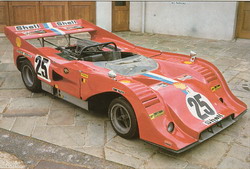 the marrow of the Colnbrook team's bones. At the Riverside finale it was
on pole by two
whole seconds,
(most runners would have given their eye teeth to pip a
McLaren to pole by two tenths) and the protests began to fly.
Eventually, to Hall's disgust, the 2J was outlawed. But if that produced
a huge sigh of relief at McLaren the future was only partly rosy. After
a backflip at St Jovite, Oliver proved an M8D
baiter in the Ti22, while Peter Revson had proved quick, especially at
Donnybrooke where he ran Hulme close from pole position, in the Lola
T220. At least one potential enemy was converted to ally status when
Revson was signed to partner Hulme for 1971, but the downside was that
Stewart would replace him at Lola, where an all-new bullet-nosed T260
was taking shape.
the marrow of the Colnbrook team's bones. At the Riverside finale it was
on pole by two
whole seconds,
(most runners would have given their eye teeth to pip a
McLaren to pole by two tenths) and the protests began to fly.
Eventually, to Hall's disgust, the 2J was outlawed. But if that produced
a huge sigh of relief at McLaren the future was only partly rosy. After
a backflip at St Jovite, Oliver proved an M8D
baiter in the Ti22, while Peter Revson had proved quick, especially at
Donnybrooke where he ran Hulme close from pole position, in the Lola
T220. At least one potential enemy was converted to ally status when
Revson was signed to partner Hulme for 1971, but the downside was that
Stewart would replace him at Lola, where an all-new bullet-nosed T260
was taking shape.
|
|
The showdown with mighty Porsche
Through 1970 Hulme had actually tested what at the time was dubbed the
M8E, which was intended to spearhead the 1971 programme, but that
designation eventually went to that year's Trojan customer car and the
works car became known as the M8F. This was similar to the D save for
full-length fences along the upper bodywork to . promote more downforce,
and 8. I-litre Chevy engines prepared once again by
Knutson. With aluminium cylinder blocks courtesy of sponsor
Reynolds, power was again increased to an incredible 740 bhp.
Where the M6A had been the design work of Robin Herd, and the M8A
that of Swiss engineer Jo Marquart, in collaboration with Bruce, the M8F
was the work of McLaren stalwart Gordon Coppuck. This time the changes
included a longer wheelbase, inboard rear brakes to reduce unsprung
weight and a stiffer chassis. Once again the . old cars were sold off to
privateers, while sundry new M8Es were sold.
The new season began with a shock, as
Stewart planted the Lola on pole at Mosport on 13 June and led
prior to gearbox problems. That left Denny to lead Peter home, a pattern
repeated at St Jovite and reversed at Road
Atlanta and Watkins Glen. However, Stewart continued to be a thorn in
the McLaren flank and duly won at Mid-Ohio when both M8Fs broke CV
joints. Revson won at Elkhart Lake but Stewart was again quick, as was
Oliver who was now in an unreliable Shadow. Revson won twice more, in
convincing style at Donnybrooke and under a cloud at Laguna Seca where
he ignored the black flag in the closing laps when leaking oil. Denny
then endorsed the McLaren domination by taking the remaining races at
Edmonton and Riverside, although he couldn't quite amass enough points
to hang on to his title, which passed to the deserving Revson. As a sign
of the opposition's desperation, sabotage was suspected at Edmonton when
a bolt was found in one of the injection trumpets on Revson's car. He
was obliged to start late while it was fished out. . . .
Thus ended the season in which the team had
faced real opposition on a consistent basis. Ultimately, although
Stewart had frequently led, the McLaren proved the better, more reliable
car; Lola was handicapped, however, by having only a single car entry.
|
|
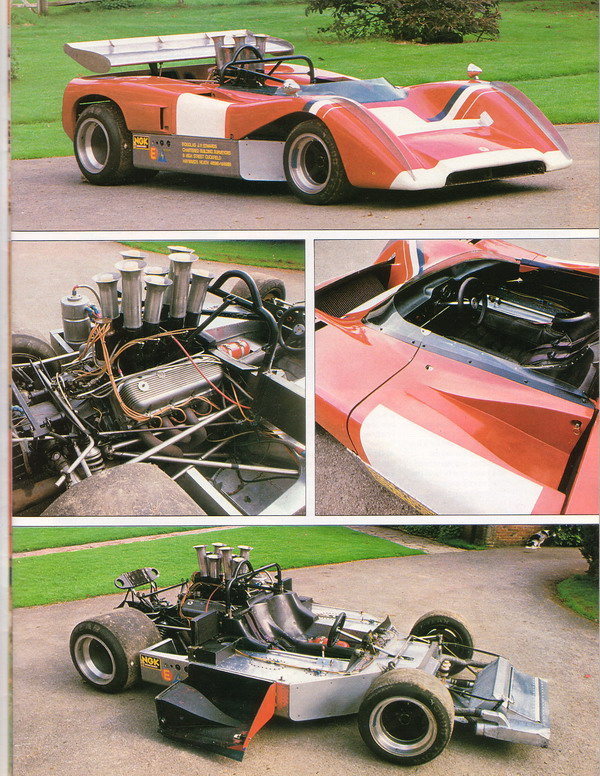
Views of another ex- VDS, ex
Johnny Jordan McLaren M8E, used in both
CanAm and lnterserie racing.
For many years this car held the lap record at Silverstone: 50 seconds
dead |
|
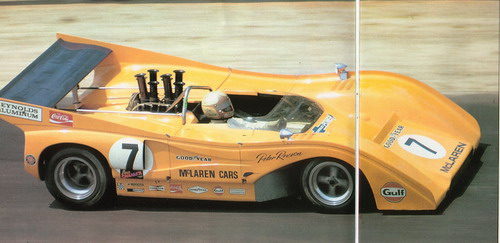
Peter Revson driving his M8F in 71 |
|
McLaren's fatal crash
Then came the news that Porsche would mount
an all-out challenge for the 1972 CanAm, and would have its efforts
managed by the highly professional Roger Penske for another skilled
driver/engineer, Mark Donohue. At last, after so many years of fighting
paper tigers, the showdown had arrived. The
CanAm town would ultimately prove big enough for only one of them.
Coppuck's response was an all-new McLaren,
the attractive M20.
 To
pack as much weight within the wheelbase for a low polar moment of
inertia, he moved the water radiators to the sides, supplemented the
usual sill fuel tanks with one behind the seat, and stretched the
wheelbase to 100 inches (254 cm). Suspension
remained much as per M8F but the bodywork was
neater and an aerofoil was slung between the two front wings. In
testing, the car was quick, and won praise
from drivers who appreciated the fact that cockpit heat from front
radiators was now a thing of the past. To
pack as much weight within the wheelbase for a low polar moment of
inertia, he moved the water radiators to the sides, supplemented the
usual sill fuel tanks with one behind the seat, and stretched the
wheelbase to 100 inches (254 cm). Suspension
remained much as per M8F but the bodywork was
neater and an aerofoil was slung between the two front wings. In
testing, the car was quick, and won praise
from drivers who appreciated the fact that cockpit heat from front
radiators was now a thing of the past.
First blood at Mosport
McLaren's other secret weapon for 1972 was a
deal with Jackie Stewart but when he had to pull out due to a stomach
ulcer, Revson was asked to. combine the CanAm with his McLaren
commitments in USAC.
It was Hulme who drew first blood at Mosport
on 11 June, baptising the M20 with
a lucky win. Donohue had run into trouble but staged a fine
recovery and just failed to pip Denny's sick car.
Revson was third. At Road Atlanta, Donohue was
replaced by George Follmer after a huge testing shunt and while the
American sped to an early debut win, Hulme
back flipped at 190 mph (306 kph). He escaped with no real injury, while
Revson set a new lap record but retired with
no oil pressure. At Watkins Glen it was Follmer's turn for trouble,
Hulme heading Revson for an M20
 1-2
with Francois Cevert third in Greg Young's ex
Revson M8F. Then, for the first time in a long while, the works McLarens
were soundly thrashed at Mid-Ohio. Follmer
won, Oliver was second in a new Shadow and
Milt Minter's Porsche beat Hulme for third. Follmer won again at Elkhart
Lake after polewinner Hulme suffered ignition failure. Revson had a dud
clutch, but Cevert was second despite a sick engine. 1-2
with Francois Cevert third in Greg Young's ex
Revson M8F. Then, for the first time in a long while, the works McLarens
were soundly thrashed at Mid-Ohio. Follmer
won, Oliver was second in a new Shadow and
Milt Minter's Porsche beat Hulme for third. Follmer won again at Elkhart
Lake after polewinner Hulme suffered ignition failure. Revson had a dud
clutch, but Cevert was second despite a sick engine.
Worse was to come,
for Donohue was out of hospital for Donnybrooke, ready to back series
leader Follmer. A ferocious duel saw the M20s stay with the turbo
Porsches until the British cars blew their engines; Donohue then blew a
tyre and Follmer ran short of fuel on the last lap. Through it all, like
a knight on a charger, came Cevert to win.
The writing on McLaren's wall
That, however, was to be McLaren's
43rd and last CanAm win. Donohue won at Edmonton after Hulme led
for a while, could have done so at Laguna Seca but slowed to let Follmer
through to clinch the title, and then had the compliment returned
at Riverside only to pick up a puncture, handing George his fifth win.
The writing on McLaren's wall said only one
thing: get out of town.
The M20s could often match the fast
Porsches' practice pace, but come the race
reliability lay with the German cars. The M20s either had to run off
pace with detuned engines, or risk mighty breakages if they tried to
match their rivals' power advantage. Hulme frequently bitched about
screwdriver-tuning for extra power, something that would eventually
become familiar in the GP world where, ironically, turbocharged
McLaren-Porsches would prove so successful.
Private McLarens appeared in the 1973
CanAm and Europe's Interserie equivalent, but the works cars never raced
beyond 1972. In the last CanAm race of 1974 at Road
Atlanta, Scooter Patrick had a lucky win
in an . ex-works car after Jackie Oliver's Shadow
blew up. They had had their period of dominance - one of the longest in
any professional racing series
- and had in
turn been dominated. Neither Teddy Mayer nor Phil
Kerr of McLaren felt inclined to try matching Porsche's
vast budget in the development of
turbocharging and as Denny Hulme finished runner up to George Follmer in
that 1972 series, the end was finally written to an outstanding chapter
in road racing. Thereafter McLaren concentrated on the high-power arena
of Formula One. |
|


