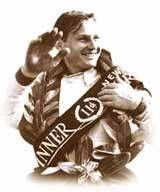
Bruce McLaren wearing laurel wreath - winner at Sebring
By Frank Falkner as published August 1970 Road & Track
IN MOTOR RACING we all mentally form intimate lists categorizing world class drivers. One is headed "Safe, highly experienced and skilled; indestructible." Bruce McLaren headed many such lists. The shock, apart from the grief, following his sudden death at Goodwood while testing the new McLaren Can-Am car was therefore intensified. Especially ironical and cruel was the fact that he had thoughtfully elected not to drive either of the two McLaren entries at Indianapolis and returned to England after that race to busy himself, typically, with testing the usual impeccably prepared Can-Am cars.
Bruce being only 33, with his ageless, joyful, youthful appearance, it was easy to forget that of all the world-class drivers he was, with the exception of his friend Jack Brabham, the most experienced of all in terms of years.
At 16 he was a secretly frightened competition license holder competing in his first hill-climb in a highly tweaked Austin 7. His father, an engineer and motor car man, had encouraged him and was his greatest supporter.
Bruce, especially when tired, had a marked limp as a result of an illness known as Legg-Perthes disease which classically descends out of the blue on previously healthy nine-year-old boys and caused them, in those days, to be placed flat on their backs in traction for periods up to two years in an orthopedic hospital. After recovery the hip joint is never completely efficient and is occasionally painful.
In retrospect, it is clear that Bruce's glorious sense of humor, resilience, patience and puckishness was born, or at least solidified, during that long period. One incident needs to be recalled. He was always a quiet leader and led, during this sojourn in the hospital, his like-aged colleagues in a grid of four-wheeled "spinal chairs" on a secret night foray down the winding, smooth, downhill paths. The steering and handling were, of course, lamentable, and there was naturally an awful multiple shunt into the flower beds. The important part of the story is that all involved-by team effort and leadership got back to their rightful bed stations totally undiscovered and unharmed.
Also of great importance in his early life were his parents. Their support and parental concern clearly helped evolve Bruce's unquestioned adult happy acceptance of life's ups and downs, his compassion; kindness, interest in others and his huge determination to succeed.
It is entirely appropriate to add the objective genetic factor of inheritable traits at this point. Bruce was the first of the New Zealand International Grand Prix Association's "Driver to Europe" scholarship winners. This scholarship got the young driver to Europe all right but left him virtually on his own on arrival. A somewhat forlorn 20-year-old Bruce with his friend Colin Beanland, acting as mechanic, set foot in England in 1958. Jack Brabham, John and Charles Cooper provided the much-needed father figures and the two New Zealanders moved into the Cooper works to literally build their own Formula 2 Cooper.
It wasn't long before Bruce was getting entries at good Formula 2 races and causing enthusiasts to look at the program to see who this small, very young Commonwealth type might be. Everyone was suddenly made to really sit up at the 1958 German Grand Prix, a combined F1 and F2 race at the Nurbürgring. The end of this episode is best summarized by Jack Brabham. "I don't know. A couple of Arabs came over with three spanners and a spare wheel just to fill up the entry list and then they win the bloody race." Bruce was 5th overall and first F2 car and stood on the victory dais beside Tony Brooks, who had won the F1 race in a Vanwall that day. At this point Bruce had truly arrived and his career in the big time started.
